
I have spent the past three days as part of a group of ten clergy men and women from different faiths and denominations in a training on leading congregations in transition. It has been a fascinating and eye-opening experience. It has been a time to reconsider some of the choices I have made in the past and to think about hopes for the future.
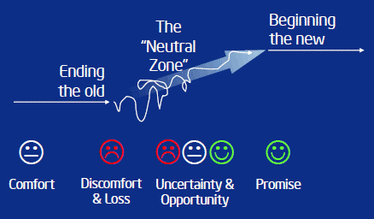
Much of the conversation over these three days centered on the role of clergy in helping congregations to negotiate the emotional and spiritual experience of big transitions. Such transitions, we learned, always have three parts: the end of the congregation's old identity, an "in between" phase of uncertainty in which the congregation rediscovers itself, and a beginning in which the new identity is born. (This model is highly influenced by the work of the late William Bridges). Congregational transitions begin with an ending and end with a beginning.
You might be tempted to think that the trick is to minimize the time spent in the uncomfortable "in between" phase (which Bridges calls "the Neutral Zone"). Not so. That is the time of possibility and discovery. Difficult, sometimes painful, things happen in the "in between," but it also is the place of inquiry, creativity, discovery and renewal. It is to be cherished, not rushed through.
And here is another important truth about congregations in transition: Change is not just handed down to the congregation by its leaders. Good leaders spend a lot of time listening to people, finding out what they want, and responding to the needs of the community. Congregational leaders who enter headlong into changes that serve only to satisfy their interests, or their pet theories, do not last long. Transition is directed by the needs of the community.
I've been thinking all week about how the insights from the training reflect on this week's Torah portion, Terumah. The portion describes the building of the Mishkan, or Tabernacle — the portable Temple that the Israelites carried with them through the wilderness as a dwelling place for God's presence. The story also suggests an ending, a middle and a beginning.
In order for the Mishkan to be built, it was necessary for the Israelites to bring donations of wood, precious metals, gems, animal skins, and yarns for its construction. Each family had to part with something that was valuable to them. They had to begin with an ending.
Then the Israelites entered a phase in which they had neither their precious objects nor a special place to experience God's presence. Before the Mishkan could be completed, the Israelites had to experience the sin of the Golden Calf and the shattering of the tablets of the Ten Commandments. It also was in this uncomfortable time that they discovered their own generosity, artistry and the new way they would organize their community. In the end, with the Mishkan completed, the Israelites saw the cloud of God's presence descend upon them and enter into them. A new beginning.
This is a process that is repeated in congregations day after day. We always are in the midst of putting together the elements of the house that will be the special gathering place of the community in God's presence. We always are gathering the resources we need to build and maintain the synagogue (or temple, church, mosque, gurdwara, etc.). We always are finding ways to transform our spiritual home to meet the needs of our times. We always are entering a new age together as a sacred community.
It is a truism that congregations always are transforming themselves and that we always are adapting to what is new. The same can be said for just about anything in life. Yet, it is helpful to be mindful of the cycle. It is too easy for the spiritual life of our communities to become stale and lose meaning when we are inattentive to the need for purposeful, intentional transitions. We need to be prepared for the grief of loss that comes with endings, for the challenges and opportunities of crossing the wilderness during the time "in between," and for celebrating new beginnings when our hopes are fulfilled.
This is going to be the story of my life in the coming year. I will be working to guide two different congregations through times of transition — the congregation I soon will be leaving and the congregation that I soon will be entering. My life — and the lives of the communities I serve — will be all about endings that are followed by beginnings. I hope to share more about the transition with you over the coming months.
May all of the transitions in your life be fulfilling as you say goodbye, cross the wilderness, and say hello.
Other Posts on This Topic:
Vayechi: Cloverleaf
Havdalah
 RSS Feed