
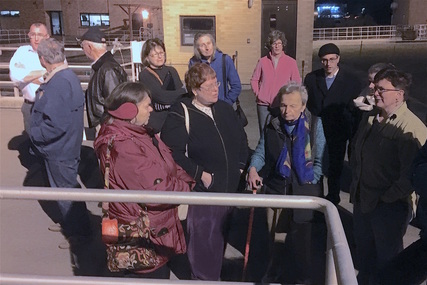
 Jewish and Catholic students in the course, "Conversations with the Earth," touring the Warwick Wastewater Treatment Facility.
 I had never taught a class at a sewage plant before, but I did this past week. Much to my surprise, it was an experience that changed the way that I think about this week's Torah portion.
The class was the final meeting of a course I taught with Professor Arthur Urbano of Providence College and William Patenaude, Principal Engineer with the Rhode Island Department of Environmental Management. Our three-part course, "Conversations with the Earth," investigated the Catholic Church's teachings on the environment, traditional Jewish understanding of our relationship to the natural world, and contemporary public policy approaches to environmental protection.
It is a topic that has attracted increasing attention in the last year. In May of 2015, Pope Francis published his second encyclical, Laudato Si', which calls on the world for "swift and unified global action" to address environmental degradation, a destructive culture of consumerism and global warming. In the Jewish world also, there have been increasing calls for environmental justice.
In the first two meetings of the course we studied the opening chapters of Genesis. We saw how, in both Catholic and Jewish interpretation, this text looms large in our understanding of our relationship to the natural world.
In the first chapter of Genesis, God says that human beings shall "rule the fish of the sea, the birds of the sky, the cattle, the whole earth, and all the creeping things that creep on earth" (Genesis 1:26, emphasis added). The second chapter says that God "took the human being and placed him in the garden of Eden to till it and tend it" (Genesis 2:15, emphasis added). The Torah offers two different visions of the relationship between human beings and nature: We are here to rule the earth, and we are here to care for the earth. So, what are we? Rulers or caretakers?
We are both. That is the wisdom of Catholic tradition and Jewish tradition. That is also the wisdom of the Warwick Wastewater Treatment Facility on the banks of the Pawtuxet River.
The facility exists because modern cities and towns require massive amounts of water to sustain their large populations. The plant treats millions of gallons of water each day to keep the population of the west side of Narragansett Bay from drowning in its own waste. There is no question that, to meet our needs and desires, we have diverted resources and exerted strong control over natural processes. We rule over nature.
However, we also give back to nature and care for it. Over the centuries, we have learned that, if we only take from nature, we ultimately will destroy ourselves. The entire point of a modern wastewater treatment plant is to make sure that the clean water that we take from nature is returned the same way we got it. That is our obligation as caretakers charged with the task to "till and tend" the earth.
Do we always do as good a job as we should to take care of the earth? Of course not. Our society is still grappling to understand and redress the harm we have done to our oceans, our rivers, the air, the land, and the climate. Balancing our roles as both "rulers" and "caretakers" of nature is, in part, the duty of engineers and lawmakers. They have the job of making sure that we reverse the harm we have done and to protect the earth in the future.
And religion also has a duty to transform our relationship with the natural world. We need to heal, not just the planet, but also ourselves. We need to forgive ourselves for ruling unwisely and we need to rediscover the joy of living in balance with the natural world. We need to remember that this world was given to us as a gift to celebrate, not to destroy. Even when our role is to "rule," we must not forget that we, too, have a Ruler whom we must serve.
This week's Torah portion, Vayikra, describes the sacrificial offerings that the ancient Israelites brought to the Tabernacle (and, later, the Temple) to worship God. As modern people, we often think of animal sacrifices as a primitive and superstitious practice that we are better off without today. Perhaps we are. However, we also should be mindful of how the ancient sacrificial offerings symbolized and reinforced a belief that we must practice balance in our relationship with nature – a belief that is sorely missing from the world today.
The ancient Israelites did not slaughter and burn animals on an altar because they did not appreciate the lives of the animals they raised. In fact, just the opposite is true. They made sacrificial offerings as a symbol of appreciation for the gifts that they had received from God and the earth. An animal sacrifice was a way of acknowledging to God that nature's bounty belongs to God. We are permitted to take a share to sustain our lives only if we complete the cycle by returning a portion back to God who is the source of all life.
This week's Torah portion also establishes a ritual for seeking forgiveness from God through animal sacrifices when we err. The Torah specifies, "When a person unwittingly incurs guilt in regard to and of the Adonai's commandments about things not to be done… the person shall bring the bull to the entrance of the Tent of Meeting before Adonai and lay hands upon the head of the bull" (Leviticus 4:2,4). Affirming the cycles of the natural world – life and death – and acknowledging our indebtedness to God is a way of finding forgiveness.
We need to feel forgiven for our sins against the natural world. In order to heal the earth, we first need to heal ourselves. We need to restore our balance with the natural world – the take and the give – in order to lift ourselves out of a cycle of guilt, despair and hopelessness about our relationship with the natural world.
If we allow ourselves to be convinced that we have plundered and desecrated the natural world beyond our ability to fix it, then we will do nothing to repair what we have done and the cycle of destruction will continue. If, on the other hand, we take the necessary steps to start giving back to the earth as much as we take, we can restore our sense of balance, our hope for a better future, and renew our role as the world's humble caretakers.
We don't have to sacrifice bulls to do that. But we do have to listen to the wisdom of the wastewater treatment plant. We can do a much better job of closing the loop of our relationship with the natural world, just as the ancient Israelites did when they gave back to God some of what they had taken. Today, we do that by replacing the clean water we use – drop for drop. We do it by planting new trees when we cut others down to build our homes and cities. We can do that by reclaiming the carbon dioxide that we release into the atmosphere to slow and reduce climate change.
We need to stop convincing ourselves that there is nothing we can do and that the destruction of the earth by human beings is inevitable. It's not. We can restore what we have broken. We can heal ourselves and heal the world.
Other Posts on This Topic:
Tu BiShvat: The Tree and the Renewal of Creation
Tzav: Transformation through Fire
The class was the final meeting of a course I taught with Professor Arthur Urbano of Providence College and William Patenaude, Principal Engineer with the Rhode Island Department of Environmental Management. Our three-part course, "Conversations with the Earth," investigated the Catholic Church's teachings on the environment, traditional Jewish understanding of our relationship to the natural world, and contemporary public policy approaches to environmental protection.
It is a topic that has attracted increasing attention in the last year. In May of 2015, Pope Francis published his second encyclical, Laudato Si', which calls on the world for "swift and unified global action" to address environmental degradation, a destructive culture of consumerism and global warming. In the Jewish world also, there have been increasing calls for environmental justice.
In the first two meetings of the course we studied the opening chapters of Genesis. We saw how, in both Catholic and Jewish interpretation, this text looms large in our understanding of our relationship to the natural world.
In the first chapter of Genesis, God says that human beings shall "rule the fish of the sea, the birds of the sky, the cattle, the whole earth, and all the creeping things that creep on earth" (Genesis 1:26, emphasis added). The second chapter says that God "took the human being and placed him in the garden of Eden to till it and tend it" (Genesis 2:15, emphasis added). The Torah offers two different visions of the relationship between human beings and nature: We are here to rule the earth, and we are here to care for the earth. So, what are we? Rulers or caretakers?
We are both. That is the wisdom of Catholic tradition and Jewish tradition. That is also the wisdom of the Warwick Wastewater Treatment Facility on the banks of the Pawtuxet River.
The facility exists because modern cities and towns require massive amounts of water to sustain their large populations. The plant treats millions of gallons of water each day to keep the population of the west side of Narragansett Bay from drowning in its own waste. There is no question that, to meet our needs and desires, we have diverted resources and exerted strong control over natural processes. We rule over nature.
However, we also give back to nature and care for it. Over the centuries, we have learned that, if we only take from nature, we ultimately will destroy ourselves. The entire point of a modern wastewater treatment plant is to make sure that the clean water that we take from nature is returned the same way we got it. That is our obligation as caretakers charged with the task to "till and tend" the earth.
Do we always do as good a job as we should to take care of the earth? Of course not. Our society is still grappling to understand and redress the harm we have done to our oceans, our rivers, the air, the land, and the climate. Balancing our roles as both "rulers" and "caretakers" of nature is, in part, the duty of engineers and lawmakers. They have the job of making sure that we reverse the harm we have done and to protect the earth in the future.
And religion also has a duty to transform our relationship with the natural world. We need to heal, not just the planet, but also ourselves. We need to forgive ourselves for ruling unwisely and we need to rediscover the joy of living in balance with the natural world. We need to remember that this world was given to us as a gift to celebrate, not to destroy. Even when our role is to "rule," we must not forget that we, too, have a Ruler whom we must serve.
This week's Torah portion, Vayikra, describes the sacrificial offerings that the ancient Israelites brought to the Tabernacle (and, later, the Temple) to worship God. As modern people, we often think of animal sacrifices as a primitive and superstitious practice that we are better off without today. Perhaps we are. However, we also should be mindful of how the ancient sacrificial offerings symbolized and reinforced a belief that we must practice balance in our relationship with nature – a belief that is sorely missing from the world today.
The ancient Israelites did not slaughter and burn animals on an altar because they did not appreciate the lives of the animals they raised. In fact, just the opposite is true. They made sacrificial offerings as a symbol of appreciation for the gifts that they had received from God and the earth. An animal sacrifice was a way of acknowledging to God that nature's bounty belongs to God. We are permitted to take a share to sustain our lives only if we complete the cycle by returning a portion back to God who is the source of all life.
This week's Torah portion also establishes a ritual for seeking forgiveness from God through animal sacrifices when we err. The Torah specifies, "When a person unwittingly incurs guilt in regard to and of the Adonai's commandments about things not to be done… the person shall bring the bull to the entrance of the Tent of Meeting before Adonai and lay hands upon the head of the bull" (Leviticus 4:2,4). Affirming the cycles of the natural world – life and death – and acknowledging our indebtedness to God is a way of finding forgiveness.
We need to feel forgiven for our sins against the natural world. In order to heal the earth, we first need to heal ourselves. We need to restore our balance with the natural world – the take and the give – in order to lift ourselves out of a cycle of guilt, despair and hopelessness about our relationship with the natural world.
If we allow ourselves to be convinced that we have plundered and desecrated the natural world beyond our ability to fix it, then we will do nothing to repair what we have done and the cycle of destruction will continue. If, on the other hand, we take the necessary steps to start giving back to the earth as much as we take, we can restore our sense of balance, our hope for a better future, and renew our role as the world's humble caretakers.
We don't have to sacrifice bulls to do that. But we do have to listen to the wisdom of the wastewater treatment plant. We can do a much better job of closing the loop of our relationship with the natural world, just as the ancient Israelites did when they gave back to God some of what they had taken. Today, we do that by replacing the clean water we use – drop for drop. We do it by planting new trees when we cut others down to build our homes and cities. We can do that by reclaiming the carbon dioxide that we release into the atmosphere to slow and reduce climate change.
We need to stop convincing ourselves that there is nothing we can do and that the destruction of the earth by human beings is inevitable. It's not. We can restore what we have broken. We can heal ourselves and heal the world.
Other Posts on This Topic:
Tu BiShvat: The Tree and the Renewal of Creation
Tzav: Transformation through Fire

 RSS Feed