
| Singing in a group is an inherently spiritual experience. It is no coincidence, I think, that every religious tradition has some practice of group singing. There is something about blending ones voice with the voices of others that has the ability to transport us out of ourselves and into a larger reality. | 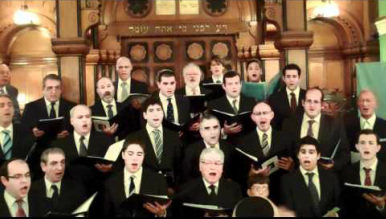 The choir of Bevis Marks Synagogue in London, the oldest synagogue in the United Kingdom. |
This week's Torah portion, I think, says something about that experience.
Parashat Bamidbar describes how the Israelites were encamped around the Tabernacle whenever they stopped their march through the wilderness. Each tribe had its own special place close to the portable Temple that was understood to be the dwelling place of God. As one would imagine, everyone wanted to get as close to they could to the God who saved them and sustained them through the desert.
Yet, there was a special place for the tribe of Levi, the tribe that included the priests and the men who were designated to care for and carry the Tabernacle. They were given the place closest to the Tabernacle and, according to a classical midrash, the other tribes made room for them there. They withdrew to allow the Levites to have the place closest to God (Midrash Numbers Rabbah 1:12).
Rabbi Yehudah Leib Alter of Ger, the author of the Sefat Emet, wonders whether the camping arrangement would have caused resentments. He says, "Surely, there must have been some Israelites of great deeds who were of greater merit than the least of the Levites." Why would they have to yield their place close to the Tabernacle in order to make way for some guy who had the job of carrying the tent poles?
To the Gerer Rebbe, the midrash teaches a lesson in humility. He says that, "Even someone great in deeds must know and believe that none of his deeds could overturn the choice of the Blessed One." Your own estimation of yourself should never be a substitute for the reality that God has delivered to you. You think that your smarts and accomplishments make you more deserving of honor than someone else? Back off, my friend. You think your piety is deeper and makes you more worthy of praise than some poser? It is all a dangerous illusion. Real piety knows the bounds of humility.
The commentary goes further. The true ideal is that we nullify ourselves (להתבטל). We should stand amongst the Jewish people and lose any sense of separation from them. It is like that experience singing in the congregation. We lose awareness of our own voice and enter into the experience of being part of something larger than ourselves.
The Gerer Rebbe says, "You should submit yourself to serve God with dedication only because it is the Blessed One’s will, and you should not think that your deeds are a means to draw closer to the Blessed One. Knowing this, how is it possible for you to hold yourself higher than even the least of Israel."
When have you had that experience? What transports you into moments when you lose yourself and feel yourself to be a part of God? In those moments, do you, too, forget the desire to get closer to God and discover yourself simply tumbling down the rabbit's hole that, paradoxically, brings us the closest we can be to God?
Other Posts on This Topic:
Vayikra: The Joy of Contrition
The Blind and the Light
"Not One of Them Was Left"
Parashat Bamidbar describes how the Israelites were encamped around the Tabernacle whenever they stopped their march through the wilderness. Each tribe had its own special place close to the portable Temple that was understood to be the dwelling place of God. As one would imagine, everyone wanted to get as close to they could to the God who saved them and sustained them through the desert.
Yet, there was a special place for the tribe of Levi, the tribe that included the priests and the men who were designated to care for and carry the Tabernacle. They were given the place closest to the Tabernacle and, according to a classical midrash, the other tribes made room for them there. They withdrew to allow the Levites to have the place closest to God (Midrash Numbers Rabbah 1:12).
Rabbi Yehudah Leib Alter of Ger, the author of the Sefat Emet, wonders whether the camping arrangement would have caused resentments. He says, "Surely, there must have been some Israelites of great deeds who were of greater merit than the least of the Levites." Why would they have to yield their place close to the Tabernacle in order to make way for some guy who had the job of carrying the tent poles?
To the Gerer Rebbe, the midrash teaches a lesson in humility. He says that, "Even someone great in deeds must know and believe that none of his deeds could overturn the choice of the Blessed One." Your own estimation of yourself should never be a substitute for the reality that God has delivered to you. You think that your smarts and accomplishments make you more deserving of honor than someone else? Back off, my friend. You think your piety is deeper and makes you more worthy of praise than some poser? It is all a dangerous illusion. Real piety knows the bounds of humility.
The commentary goes further. The true ideal is that we nullify ourselves (להתבטל). We should stand amongst the Jewish people and lose any sense of separation from them. It is like that experience singing in the congregation. We lose awareness of our own voice and enter into the experience of being part of something larger than ourselves.
The Gerer Rebbe says, "You should submit yourself to serve God with dedication only because it is the Blessed One’s will, and you should not think that your deeds are a means to draw closer to the Blessed One. Knowing this, how is it possible for you to hold yourself higher than even the least of Israel."
When have you had that experience? What transports you into moments when you lose yourself and feel yourself to be a part of God? In those moments, do you, too, forget the desire to get closer to God and discover yourself simply tumbling down the rabbit's hole that, paradoxically, brings us the closest we can be to God?
Other Posts on This Topic:
Vayikra: The Joy of Contrition
The Blind and the Light
"Not One of Them Was Left"
 RSS Feed