I was asked this question by three separate people at last night's community seder, and probably a dozen more times throughout the year. I figure that there must be many more folks who are uncertain about it, so I thought it would be a good idea to answer the question and also offer some reflections on its meaning for contemporary Jews.

Is there one seder, or two? Is Passover seven days long, or is it eight?

In Exodus, chapter 12, the Torah says, as plain as day, that the ritual meal commemorating the exodus from Egypt—the origin of the seder—shall begin at twilight on the 14th of Nisan. It does not say anything about a meal on the evening of the 15th day, or any other. The text goes on to say:

You shall celebrate a sacred occasion on the first day, and a sacred occasion on the seventh day; no work at all shall be done on them; only what every person is to eat, that alone may be prepared for you. You shall observe the [Feast of] Unleavened Bread, for on this very day I brought your ranks out of the land of Egypt; you shall observe this day throughout the ages as an institution for all time. In the first month, from the fourteenth day of the month at evening, you shall eat unleavened bread until the twenty-first day of the month at evening. (Exodus 12:16-18, JPS Translation)

How did we end up with the idea that Passover is celebrated for eight days, when the Torah says seven? Where do we get seders on the first two nights, when the Torah only mentions a special meal on the first night?

The answer is that the rabbis instituted an additional day to all of the Torah-commanded festivals (except Yom Kippur) because of a problem in reckoning dates. In the early centuries of the common era, the new month was declared by the actual observation of the moon in Jerusalem. A month could not begin until the first sliver of the new moon was actually sighted and reported to the Sanhedrin (the chief rabbinic council). 

This, of course, created a problem for any community that was more than a day's travel from Jerusalem. A lunar month is approximately 29.5 days long. If you know what day the last month started, there are only two possibilities for the first day of the next month. It's either the thirtieth day after the last new moon or it's the thirty-first. But, how could people far from Jerusalem know which one to start on without a message from the Sanhedrin?

For Jewish communities in far away Babylon and Alexandria, information about the correct date could take weeks. The rabbis tried different methods to spread the news more quickly. A system of bonfires on mountain tops was instituted to announce the new month, but this system was easily foiled by opponents of the rabbis and Israel's enemies who set false fire signals. 

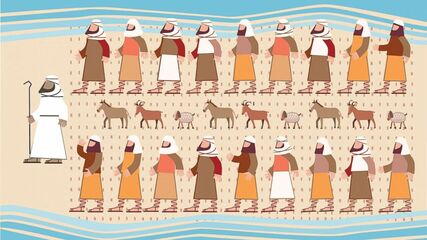
Eventually, the rabbis adopted a system in which communities outside the land of Israel were required to observe Torah-ordained festivals on two days—one day that would be correct if the previous month had been 29 days long, and one that would be correct if it had been 30 days long. All of the rituals associated with Rosh Hashanah, the first day of Sukkot, Sh'mini Atzeret, the first and last days of Passover, and Shavuot were repeated for a second day. This second day of the holiday for the diaspora, yom tov sheini shel galuyot, is the reason for two seders and for a total of eight days of Passover. 

In the fourth century, the rabbis switched to a calendar based on mathematical calculation of the lunar cycle instead of direct observation. This is the Hebrew calendar we still use. However, by that time, the practice of adding a second day to the holidays had been established as a permanent practice. In fact, the celebration of Rosh Hashanah as a two-day holiday had become so ingrained that it was observed even in Jerusalem, the city that knew the date of the new moon better than any other.

That's the way the holidays stayed until the Reform Movement arose in the 19th century. The early Reformers declared that the reason for the extra day of the holidays had disappeared more than a thousand years earlier, so they restored the biblical pattern of the holidays with only one day for Rosh Hashanah and seven days of Passover. However, the extra day of the festivals continues to be practiced today outside of the land of Israel by Orthodox and Conservative Jews. Inside the land of Israel, everyone observes the same holiday calendar. 

Just to make matters even more confusing, many Reform congregations in the diaspora, for a variety of reasons, now have re-adopted the practice of observing two days of Rosh Hashanah. Also, many Reform congregations (like the one I serve) offer a congregational seder on the second day of Passover to bring the community together on one of our most cherished holidays. We may say that, as Reform Jews, we do not observe the second day of Passover as a full holiday, but, for practical reasons, we do offer a second seder.

Is the diversity of calendars and holiday practices good for Judaism or is it bad? I find that to be a difficult question to answer. I certainly have seen Jews—some Reform and some Orthodox—who become indignant about those "other" Jews who don't observe the holidays the "right way." That kind of partisan and chauvinistic attitude separates one Jew from another is certainly not "good for the Jews."

On the other hand, diversity within the family of the Jewish people can also be seen as a good thing. It keeps us thinking about why we do what we do and it opens up our minds to new possibilities. Reform Judaism has become better in recent decades because it has faced the challenge represented by Orthodoxy and has responded by re-imagining rituals that were once discarded—like immersing in the mikveh and wearing a talit—and has injected new life and meaning into them. Orthodoxy, too, has become better by adopting worship practices that were innovated by Reform Judaism—like communal singing in worship services and greater roles for women. 

Whether you observed Passover this year with one seder or two, it is likely that your seder was different than the one your grandparents observed fifty years ago. That difference, in all likelihood, can be traced back to an influence inspired by the diversity of Judaism in the twentieth and twenty-first centuries. 

Let a thousand seders bloom.


Other Posts on This Topic:
A Pesach Lesson from Yoga: Freedom Comes in Two Flavors
Mishpatim: The Purpose of the Torah
 
 
Tonight's seder for the second night of Passover also coincides with the end of Shabbat. Traditionally, an extra paragraph is added to the blessing over the first cup of wine to make the havdalah blessing for the end of Shabbat. We do not use the usual twisted candle for havdalah; the blessing for "eish" (fire) is made over the festival candles.

The blessing ends on what sounds like an odd note. Usually, at the end of the havdalah ritual, we bless God, hamavdil bein kodesh l'chol,  "who makes distinction between sacred and ordinary." That is, we acknowledge that God makes a distinction between Shabbat, a holy day, and the ordinary days of the week. Tonight, however, when Shabbat is immediately followed by a second day of the festival, the blessing changes to hamavdil bein kodesh l'kodesh, "the One who makes distinction between sacred and sacred."

We make a blessing to acknowledge that there is a difference between the sanctity of Shabbat and the sanctity of Passover. There is something interesting and, perhaps, even profound about the idea that sanctity comes in different flavors. The blessing seems to be an secret invitation for us to discover and name all the different families, genera and species of holiness.

Is there a holiness of human beings that is different from the holiness of plants and other animals? In Jewish tradition, we make blessings for getting out of bed in the morning, for drinking a glass of water, and for using the bathroom. Do each of these everyday activities have a different type of holiness? Is the holiness of a sunrise different from the holiness of a sunset? 

Whenever I meet with people in my synagogue office, I try to recognize each person as a holy representation of the image of God. It is helpful, somehow, to recognize that each person may posses a different kind of holiness. We each are different and each bring a different aspect of divinity into the world. Blessed is the One who makes distinction between my sacredness and your sacredness.

To carry the thought a bit further, there is also this. The day I married my wife is sacred to me. The day each of my children was born is sacred to me, and each in different ways. The day each of my grandparents died, the day I first walked in the land of Israel, the day I became a rabbi, the day that I began to serve the congregation that is my spiritual home…all of these moments are sacred to me, each in its own way. 

Part of the challenge of religious living is to seek out the holiness in each moment. Each experience and each moment of our lives can be sacred in a different way. Whether it is a moment when I am laughing with my children, a moment when I am frustrated with a student, a moment when I am washing the dishes, or a moment when I am holding the hand of a person who is sick, each moment can be a holy moment in the rainbow of holy moments. 

Baruch Atah Adonai, Eloheinu Melech Ha-Olam, Hamavdil bein Kodesh l'Kodesh.


Other Posts on This Topic:
Havdalah
 
 
Pesach and Opening Day

On Opening Day, the cleats are all unscuffed
And the mitts are freshly oiled.
The helmets are free of pine tar
And every bat boy's uniform is freshly pressed.
On Opening Day, all is readiness 
And nothing has been accomplished.
The standings are all even,
No wins and no losses.

Pesach begins that way, too.
All the crumbs have been swept out of the bread drawer.
The jars of gefilte fish stand in a line on the counter.
There is not a single wine stain on the white tablecloth.
All is readiness. Nothing has been accomplished.

Before this day can matter, matzah must shatter
Under too hard butter.
Before this day counts, fans must hope, 
Savor victory, 
And regret a wasted late-inning chance.

Freedom cannot be pristine.
It has to be sought, battled and won.
We stand this day on the shores,
Looking out at the impossibly wide sea,
Wondering how we will get across.
It takes that first pitch,
The first bad call and the first missed sign
To know what we are willing to lose.

When Nachshon (or Casey) puts his big toe 
Into the sea (or the batter's box),
And risks everything,
That is the moment in which we leave the world
Of pre-game perfection
And enter the world of redemption.

(Play ball!)


Other Posts on This Topic:
Why Torah is Like Baseball
Thoughts on Torah, Redemption and Spring Training
 
 
My younger daughter and I made matzah yesterday evening. (It’s surprisingly easy). I do this most years in preparation for Passover and we use the homemade matzah to fulfill the mitzvah of eating matzah at the seder. My daughter begged to help me; making matzah is a lot of fun for kids.

I had this moment of realization while making the matzah that seems to strike me every year, as if for the first time. While squishing the dough between my fingers, I remembered why all matzah must be baked before the holiday begins. Once Passover starts, no more matzah can be made.

The reason is surprising, simple and paradoxical: It is impossible to make matzah without also making chameitz.

So, I need to give a bit of background here. Matzah is the flat, unleavened bread that is eaten during Passover as a sacred obligation. It is made by combining flour and water, mixing them quickly, and placing the flattened dough into a very hot oven within eighteen minutes, before it has time to rise.

We usually think of chameitz as the opposite of matzah. It is any food made from grain that is not matzah. Bread, cookies, cake, beer, pasta, cereal and grain-based liquors are all examples of chameitz. All are forbidden during Passover. Chameitz, during Passover, represents our “puffy” egos and inflated sense of self. Not only is it not permitted to eat these foods, according to traditional Jewish law, one is not even permitted to own chameitz during Passover. 

And this is the reason why you cannot make matzah during Passover. In the simple act of combining flour and water, chameitz is a necessary by-product. Any water-flour combination that does not enter the oven within eighteen minutes becomes chameitz

As I was making the matzah with my daughter, we were constantly cleaning off the white, sticky dough that covered the rolling pins, the counter, our hands and our aprons like glue. All of it becomes chameitz; all of it would be forbidden to be in our house after Passover begins on Friday evening.

This is the paradox of matzah and chameitz. They are not really opposites. Rather, the distinction is only in the arbitrary conceit that flour and water turn into chameitz in eighteen minutes. Matzah and chameitz are separated only by the fire of the oven and the fire of our imaginations. 

There is a teaching about this narrow distinction between matzah and chameitz based on the similar spellings of the two words in Hebrew. Matzah is spelled mem, tzadi, hey. chameitz is tzadi, mem, chet. The two words are as close to each other as the two letters hey (ה) and chet (ח)—distinguished only by a small gap in the hey. The only difference between matzah and chameitz is in that gap, a narrow space in which we allow God to enter.

The fact that we cannot make matzah without making chameitz reminds us during Passover that we cannot create any holiness in our lives without also introducing the possibility of its shadow. We cannot make ourselves more holy without also introducing arrogance and self-aggrandizement into our egos. We cannot purify ourselves spiritually without also risking the possibility that we will thereby separate ourselves from others. Like matzah and chameitz, sacred holiness and gross arrogance are not really opposites. They are separated only by the small gap of how we invite God into our consciousness.

The matzah we made with our own hands is, like us, both spiritual and earthy. It is bound up in the sweat and labor of ploughing fields, growing grain, grinding, kneading and baking. At the same time, it is elevated to the sacred by careful attention to our intentions. By noticing the subtle differences between pious humility and arrogant self-righteousness, between hey and chet, between matzah and chameitz, we discover how we can be both material and divine.


Other Posts on This Topic:
Shabbat HaChodesh: The Death of Little Things
Bedikat Chameitz
 
 
There is no Jewish ritual that requires more planning than the Passover seder. It is not just the cleaning and removal of chameitz from the house. It is not just the meal planning, the shopping, the baking and cooking. It is not just setting the table, reviewing the Haggadah, and planning the seder. On top of all of that, the really hard part is doing it all in ways that inspire us, spiritually move us, and fill us with joy. 

Here are some ways to plan joy into your seder:

1) Answering children's questions is the main purpose of the seder and it is the experience that gives the seder a heart and soul. Get started early on helping the children attending your seder to have questions that they are genuinely curious about. Read Passover stories with them and start writing down the questions they ask. Even better, get them to tell you the story and find the questions together with them. The haggadah reminds us that we have an obligation to teach each child in a way that is appropriate to his or her abilities and interests. Make sure that you get older and more curious children to ask deeper questions in a way that will keep them interested—How do we experience slavery in our lives today? Where is Pharaoh in the world today and where is Pharaoh in our own hearts?

2) Keep a balance between traditions and new innovations. Many of the joys of the seder come from doing things exactly as they have been done in the past—with cherished ritual objects, favorite recipes, and the little details that make the seder your own. Be aware, though, of the places where traditions have outlived their purpose or have grown stale. My family use to conduct our seder under a tent in the living room as a way to give us more room and make the seder more exciting for the kids. After a few years, though, the innovation turned into a just another "thing we're supposed to do," so we dropped it. Try at least one new thing every year.

3) Don't turn the Haggadah into an idol. I love the poetry of the Haggadah, but I know that there are plenty of seders in which reading the words becomes more important than finding meaning in them. It is helpful to remember that the Haggadah developed over centuries. In its original form, the Haggadah was little more than an outline of topics and a series of suggestions for conducting the seder. Give the Haggadah its due, but make sure its message doesn't get swallowed up in its words.

4) Sing. Sing. Sing. The seder has some of the funniest and oddest music in the entire repertoire of Jewish liturgy. Enjoy it and sing it out. When else during the Jewish year do we sing a sacred song about how "it would have been enough" for God to deliver us from Egypt even if we never got the Torah? How odd is it that we ask our children to sing a song of questions that we never completely answer? Who can explain a song that is the Jewish equivalent of "There Was an Old Lady Who Swallowed a Fly"? Have fun with them all.

5) Share your seder. There is a moment in the seder in which we open the door and invite all who are hungry to join us. It should not be just a symbolic gesture. There are plenty of people who hunger for food and there are plenty of people who hunger for spiritual and community connection. Invite them to your seder and discover how much more joyful your seder can be when you welcome others to join you, especially those who may not otherwise have any seder to attend.

What are your suggestions for a more joyful seder? Let us know in the comments.
 
 
This coming Shabbat has a special name and a special meaning. It is Shabbat HaChodesh, the Shabbat that proceeds (or, as this year, falls on) the first day of the Hebrew month of Nisan. 

As the Torah tells us (Exodus 12:2), Nisan is the first month of the year. So, Rosh Chodesh Nisan is the first Rosh Chodesh of the year. 
Picture
Photo by Jon Sullivan
Nisan, of course, is also the month of Pesach (Passover), the most labor-intensive holiday of the year. For many families, Rosh Chodesh Nisan marks the beginning of the long process of cleaning out the entire house of chameitz (any food made from grain that is not matzah) and getting ready for the seder. This is, in fact, what the Israelites did to prepare for the first Pesach when they were still slaves in Egypt. We read in Parashat Bo:

Adonai said to Moses and Aaron in the land of Egypt, "This month is your first new month of the months of the year. Tell the whole community of Israel, 'On the tenth day of this month, each of you will take a lamb (or kid) to your household, one lamb for each family.… It will be yours to watch over until the fourteenth of this month, when you will slaughter it, all of the gathered community of Israel, at twilight.'… In the first month, on the fourteenth day of the month, in the evening, you shall eat matzah until the twenty-first day of the month, in the evening. For seven days, nothing leavened shall be found in your house, for anyone who eats chameitz, that person shall be cut off from the community of Israel, whether stranger or citizen of the land." (Exodus 12:1-3, 6, 18-19)

Imagine. From the tenth day of the month, each family had that little lamb or baby goat in their home. They heard it bleating for its mother. The children played with it. 

For more than four days the Israelites watched over that little animal, knowing what its fate would be as they cleaned out the chameitz from the entire house. They knew that, once their work was done, it would be more than a meal. It would be their escape from the angel of death and a ticket to freedom. The blood of the baby animal would be painted above the doors of their houses. The meat would be the main course, eaten with matzah and bitter herbs, at the first seder. 

This is what it means to prepare for the seder, to prepare for our freedom. It means painfully watching the death of something that you have gotten used to. It means allowing yourself to be uncomfortable about saying goodbye. It means constantly having to remind yourself that there is a good reason for going through all of this. Slavery is hard. Giving up slavery can be hard, too.

There is still real slavery in this world, but most of us will never know it. (Be grateful for that.) On Pesach, we can focus on a different kind of slavery. It is the slavery of all the habits and bad behaviors that we cling to—the way we won't give up eating things we shouldn't, using our power in ways we know we shouldn't, giving in to our anger and fear in ways that hurt us. Letting go of all that is more difficult and more painful than scrubbing the bottom of the bread drawer or cleaning out the black gunk stuck the inside walls of the refrigerator.

Preparing for Pesach is intense and it is meant to be difficult. This Shabbat, we remember what it means to prepare for a new beginning and to suffer over the little things that we fear to let die. We just have to remind ourselves, over and over, that it is our ticket to a new world of freedom.


Other Posts on This Topic:
Bedikat ChameitzShabbat HaChodesh: Prepare for Freedom!
 
 
"Adonai, our God, You redeemed us from Egypt and You rescued us from the house of bondage. You slew all their firstborn and You redeemed Your own firstborn. You split the waters of the Sea of Reeds. You drowned the wicked; You saved the beloved. The waters covered their enemies and not one of them was left." 

That is part of the traditional text of the Ge'ulah blessing—the blessing for redemption—that is recited every morning right after the recitation of the Shema. (This part of the blessing is edited out of Reform prayerbooks). 

Tradition says that today, the seventh day of Pesach, is the anniversary of that day when God parted the waters for the Israelites and allowed the sea to come crashing down on Pharaoh's army. We've been paying for it ever since.

The rabbis of the midrash and the Talmud cringed at the thought that God would choose to murder the Egyptians in order to rescue the Israelites. According to one midrash, God shushes the angels in heaven when they cheer the destruction of the Egyptians.  "My creatures are drowning," says God to the angels, "and you would sing praises to Me?"

As I look at the words of the Ge'ulah blessing tonight, though, I notice for the first time that the wording is ambiguous. Who is wicked? Who is beloved? Whose heads were covered with water? Such ambiguity cries out to be interpreted.  Why couldn't the prayer just say, "You drowned the Egyptians and You saved us"?  There has to be a reason.

The reason, I think, is to remind us that it could just as easily be the other way around. God does not favor Israel just because it is Israel. God does not punish Israel's enemies just because they are our enemies. That kind of easy triumphalism is exactly what the author of the blessing wants to avoid. There is no promise that Israel is the redeemed in the text, just the possibility of being the saved beloved, which exists alongside the possibility of being the wicked drowned.

"Egypt" (Mitzrayim, in Hebrew) is not just a country in the rabbinic imagination. It is the very idea of the human ego running amok with self-adoration. Mitzrayim is the place of narrowness (the word tzar, hidden within "Mitzrayim," means "narrow.") It is the place where we put on the blinders that keep our vision from expanding to include anything but ourselves. The rabbis were right to cringe. It wasn't an army of Egyptians that God chose to wipe out. It was the egotism that allows human beings to see only themselves until not one other human being is left.

The idea that we would think ourselves great because God saved us from Mitzrayim is the very opposite of the lesson intended from this story. The Ge'ulah blessing had to be written in a way that denied the self-congratulatory reading. Our joy on the seventh day of Pesach is not the product of thinking ourselves special or superior. Rather, it is the joy of humility that we experience when we realize that we are loved despite ourselves.

The seventh day of Pesach is a major festival day, a festival of humility. Unlike every other major pilgrimage festival day of the year, we recite only the short version of the hallel psalms today. We remind ourselves not to be too loud when we praise God for transforming us from slaves into free people. This day is set aside for recognizing that the deepest joy is not the joy of boasting. Rather, it is what we experience when we take off the blinders and see a world much bigger and richer than it could be if it were our invention alone.
 
 
Tonight, my children and I performed one of their favorite rituals, and I have to admit that it is one of mine, too.

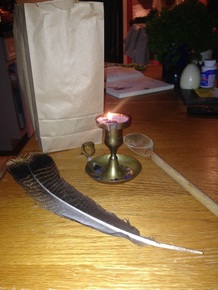
I brought them down to the bottom of the stairs in the dining room, which was in total darkness, and asked my older daughter to light the candle while her sister held the feather and the large wooden spoon.  I held the paper bag. Together, we made the blessing for the search for chameitz (leavening). 

Baruch atah Adonai Eloheinu melech ha'olam asher kid'shanu b'mitzvotav, v'tzivanu al biur chameitz.  Blessed are you, Adonai our God, Source of all being, who makes us holy with mitzvot, and commands us to remove chameitz.

I told the girls that our search for the ten pieces of bread (which they knew I had hidden a few minutes before) would be done only by the light of the candle and, as much as possible, in silence. We were searching not only for pieces of bread, but also searching ourselves for all the stuck places in our hearts where we wish to free ourselves. The two of them started wandering through the house, holding back their squeals of delight each time one of them spotted a square of quartered sandwich bread. The feather would come out to sweep it into the spoon and then the spoon would deposit it into the bag.

Why do my girls love this ritual so much? Of course, there is the excitement of knowing that Pesach (Passover) begins tomorrow night. There is also the fun of carrying the lit candle through the house and playing with the props of feather and spoon. Maybe that's it.  Maybe they also really like seeing how seriously I take all the Pesach preparation and give them their own special role in all the madness. Maybe, they also get some of the deeper stuff. Maybe.

I know why I love this ritual. I love the way we use rituals to do the impossible and pretend that we have accomplished a miracle.  We are supposed to rid our homes on this night of every vestige of leavening. Every single molecule of grain in the house is to be hunted down and exterminated so that the festival can be celebrated in a state of purity and perfection. We pretend that it is so, and in so doing, we really do perform a miracle. 

It is the miracle of creating within our souls the memory of deliverance. We were slaves and now we are free. Our imperfect lives — so filled with so many forms of self-imposed servitude — are redeemable. We are made free with a word, a spoon and a feather.

The pieces of bread are all gathered in the bag.  (Well, actually, all but the one that the dog found and ate while I was trying to find a feather.) Tomorrow morning I'll burn the bag on my driveway and utter a formula declaring my home to be free of chameitz. I'll be ready to sing the songs and drink the cups of wine at the seder tomorrow night.  I'll know, against all material evidence to the contrary, that I personally was delivered from slavery in Mitzrayim. A miracle.

Tonight, my children and I performed one of their favorite rituals, and I have to admit that it is one of mine, too.
 
 
In Jewish tradition, Pesach (Passover) is called Z'man Cheruteinu, the season of our freedom. Tradition also tells us that on Pesach we are  to consider ourselves as if we, personally, were delivered from slavery in Egypt. That must mean that the freedom we celebrate on Pesach is not just the remembrance of a long-ago liberation. Pesach is a time to experience and act upon the freedom in our life today—in the here and now.

During the weeks before Pesach this year, I've been trying to put more focussed attention on freedom and what it means to me in my personal life. I ask myself: In what ways am I free? How do I unintentionally constrict my freedom? What do I do with the freedom I have?

By coincidence (if you believe in that sort of thing), my amazing yoga teacher chose to talk last week in class about freedom. "Freedom," she said, "comes in two flavors: freedom from and freedom to." We experience "freedom from" when we remove ourselves from the things that hurt us or confine us. It's the kind of freedom that we celebrate when we see a dictator fall or when we decide to move beyond the limitations of our own past. "Freedom from" is liberation from confinement and contraction. 

"Freedom to," though, is a different sort of experience.

"Freedom to" is the experience of reaching beyond our present selves to expand the limits of our potential. We celebrate this freedom when we try new things, embrace new ideas, and attempt to do things we thought were impossible. Where "freedom from" is an act of self-preservation and self-affirmation, "freedom to" is an act of self-discovery and self-transformation. Exercising "freedom from" helps us to feel secure; exercising "freedom to" helps us to feel expansion and joy.

The entire discipline of yoga can be oversimplified as the practice of developing a sound foundation that is rooted in reality — an act of "freedom from" — and reaching from that foundation, to the extent our bodies will allow, to create a new reality — an act of "freedom to." Yoga poses are built on a secure connection to the ground that expands outward and upward into an expression of courage and joy.

Much the same thing, I believe, happens in Judaism. 

Living a life of Torah begins with the grounding principles of ethics, reverence, humility, and acceptance of the mitzvot. However, building this foundation alone is not enough. A life of Torah also means living with love, joy and courage to strive toward our greatest potential and possibility. Adhering to halakhah (Jewish law—however one may understand it) is only half the battle. The other half is to be a warrior in the cause of self-transformation and self-discovery. It is to become the champions of our own lives.

My tendency during Pesach is to focus on the first part. I get very caught up in the search for hametz (leavening), the rituals of the seder, and keeping the dietary restrictions of the holiday. This year, I want to let the second part receive the energy it deserves, too. I want to make Pesach a time of exercising my freedom to be more in touch with the needs of my family and the others I love, to try new ways of expressing myself creatively, to make new connections with people and with community. 

Those things, too, are part of what we celebrate when we identify with the liberation from Egypt. After all, it would not have been enough (dayeinu!) if the Israelites had only left the confinement of Egypt and not marched onward and upward toward the Land of Israel. The full celebration of z'man cheiruteinu is to break free of the places in our lives where we are stuck in narrowness, and then to discover the joy of becoming the people we are yet to be.

Chag sameach!
 
 
A mezuzah on the door. A set of silver Shabbat candlesticks on the table. A Torah commentary on the bookshelf. These are some of the objects you might see at my house that declare it to be a Jewish home, even to the casual observer. Each of these objects, too, suggests that there is something sacred about a Jewish home.

Of course, what really makes a Jewish home a sacred place is more than special objects. Real holiness, in Judaism, is not conveyed by holy relics. Jewish tradition has always been a bit shy about the idea that a physical object can be holy.  That would smack as a bit too idolatrous. The closest we come to declaring an object holy, perhaps, is a Torah scroll or the written name of God. Even then, the tradition acknowledges that such objects gain their holy status only from the intention of the people who create and use them, not because of an intrinsic closeness to God.

The holiness of a Jewish home really comes from the relationships and behaviors within the home. When couples treat each other with loving dignity and care, there is holiness in the home. When parents spend time with their children to teach them the essential values of compassion, integrity, justice, humility and reverence, there is holiness. When visitors are treated with hospitality and open-heartedness, then the home becomes a holy place in a way that is more meaningful than any mezuzah could convey.

This week's Torah portion, Metzora, deals with the strange phenomenon of a house that has contracted a disease. Many commentators puzzle over the possibility that a house could have tzara'at, the skin ailment that is usually (but wrongly) translated as leprosy. 

One commentator, Rabbi Yehudah Lieb Alter of Ger (known as the Sefat Emet), says that the idea that a Jewish home could contract the disease is an indication of just how holy a Jewish home can be. Tzara'at is understood in Jewish tradition as a disease of the soul; it is a physical manifestation of a moral or spiritual brokenness. Rabbi Lieb says that "Israel’s holiness is so great that they can also draw sanctity and purity into their homes." How else could a home contract a disease that afflicts holiness?

This week, as we prepare for the holiday of Pesach, our attention is drawn to the holiness of our physical homes as it is at no other time of the year. We begin the process of removing chametz (leavening) from our home to purify it for the coming holiday. There is a tendency to become a little obsessive about removing every crumb from every corner of the house.  (I speak from personal experience).  I want to suggest, though, that the obsession with the physical aspect of purifying our homes should not overshadow the more important task of revealing the sanctity of our homes.

In preparation for Pesach, you may wish to think about they ways that you make your home a sacred place with respect to the relationships and behaviors within it. Take time to repair any brokenness in the ways that members of your household treat each other. Make the process of searching for leavening also a process of searching for opportunities to renew the sanctity of loving relationships. In this way, we affirm the sanctity of our homes.