
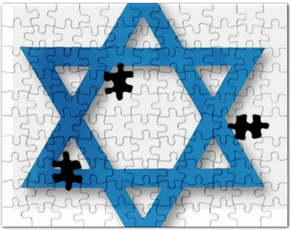
Today is the first day of Elul, the month of the Jewish calendar that immediately proceeds Rosh Hashanah and the Days of Awe. The month of Elul begins the period of introspection and seeking forgiveness that prepares us for Yom Kippur. During this month, it is traditional to sound the shofar at the end of each weekday morning services as a kind of spiritual alarm clock to rouse us to renewed awareness.
Yet, I know what this time of year means to many American Jews. If you are a member of a Jewish congregation, the beginning of the month of Elul is a time to think about reconnecting with your Jewish community after the long summer. But, for those 70% of American Jews who are not affiliated with a congregation, this is the time of year you might ask yourself the question, "Where, if anywhere, do I fit in?" The American Jewish community has a lot of missing pieces.
Congregational leaders often assume that unaffiliated Jews have made the choice not to care about Judaism and not to value the Jewish community. They think those pieces are missing from the puzzle because they have decided that they just don't want to be a part of it. But my experience is different. I encounter a lot of unaffiliated Jews who crave a connection, but they despair that they cannot seem to find a fit.
Some of these unaffiliated Jews anticipate rejection because of intermarriage. Some are searching for spiritual answers in life, but are put off by congregations that don't seem to address their questions. Some are just convinced that synagogue membership is too expensive or that the culture of congregations is too cliquey. Some have had bad experiences with previous congregations or previous rabbis and don't want to get burned again. There are more barriers facing unaffiliated Jews than many people imagine.
So, at this time of year, many unaffiliated Jews wonder if it is really worth the effort to try. They think about the hassle of paying for High Holy Day tickets at a congregation where they may not feel welcomed, or where they might get badgered about joining. Still, they might remember positive associations with Judaism from their childhood, or hope that there is something meaningful to be experienced on Yom Kippur this year, despite the negative experiences of their past. Will it be enough to get them to walk through the synagogue doors?
This year, on this first day of Elul, I ask those who do feel connected and do feel part of a meaningful Jewish community, to think about those who are wondering whether it's worth the effort. Think about the experiences you have had that have made you feel connected. Remember how being part of Jewish community has been one of the most joyful and fulfilling parts of your life. Be mindful of how living and learning Torah has brought depth and meaning to your soul. Think then, also, about how you can help somebody else have a similar experience.
Invite someone who feels disconnected from Judaism to have dinner with your family on Erev Rosh Hashanah. Ask someone to come to services as your guest. Encourage a Jewish teen who is on the periphery to go to a youth group event with your kids. Invite someone to enter into the social circle of your temple friends. Suggest that they sign up for an adult education class. Just forward this post to a friend and ask, "Is this you? Can I help?" The greatest mitzvah you can do this year, and the greatest act of repentance you can do on behalf of the Jewish community, might be to help put some of the pieces back together.
Rosh Chodesh tov. Have a good new month.
Other Posts on This Topic:
The Rabbi's 47%
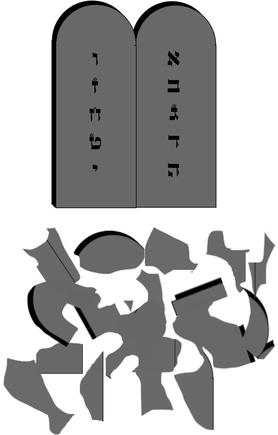
Broken Tablets and Whole Tablets
Yet, I know what this time of year means to many American Jews. If you are a member of a Jewish congregation, the beginning of the month of Elul is a time to think about reconnecting with your Jewish community after the long summer. But, for those 70% of American Jews who are not affiliated with a congregation, this is the time of year you might ask yourself the question, "Where, if anywhere, do I fit in?" The American Jewish community has a lot of missing pieces.
Congregational leaders often assume that unaffiliated Jews have made the choice not to care about Judaism and not to value the Jewish community. They think those pieces are missing from the puzzle because they have decided that they just don't want to be a part of it. But my experience is different. I encounter a lot of unaffiliated Jews who crave a connection, but they despair that they cannot seem to find a fit.
Some of these unaffiliated Jews anticipate rejection because of intermarriage. Some are searching for spiritual answers in life, but are put off by congregations that don't seem to address their questions. Some are just convinced that synagogue membership is too expensive or that the culture of congregations is too cliquey. Some have had bad experiences with previous congregations or previous rabbis and don't want to get burned again. There are more barriers facing unaffiliated Jews than many people imagine.
So, at this time of year, many unaffiliated Jews wonder if it is really worth the effort to try. They think about the hassle of paying for High Holy Day tickets at a congregation where they may not feel welcomed, or where they might get badgered about joining. Still, they might remember positive associations with Judaism from their childhood, or hope that there is something meaningful to be experienced on Yom Kippur this year, despite the negative experiences of their past. Will it be enough to get them to walk through the synagogue doors?
This year, on this first day of Elul, I ask those who do feel connected and do feel part of a meaningful Jewish community, to think about those who are wondering whether it's worth the effort. Think about the experiences you have had that have made you feel connected. Remember how being part of Jewish community has been one of the most joyful and fulfilling parts of your life. Be mindful of how living and learning Torah has brought depth and meaning to your soul. Think then, also, about how you can help somebody else have a similar experience.
Invite someone who feels disconnected from Judaism to have dinner with your family on Erev Rosh Hashanah. Ask someone to come to services as your guest. Encourage a Jewish teen who is on the periphery to go to a youth group event with your kids. Invite someone to enter into the social circle of your temple friends. Suggest that they sign up for an adult education class. Just forward this post to a friend and ask, "Is this you? Can I help?" The greatest mitzvah you can do this year, and the greatest act of repentance you can do on behalf of the Jewish community, might be to help put some of the pieces back together.
Rosh Chodesh tov. Have a good new month.
Other Posts on This Topic:
The Rabbi's 47%
Broken Tablets and Whole Tablets

 RSS Feed