
Tonight begins Shabbat HaGadol, the Shabbat before Passover whose name means, "The Great Sabbath." It is reasonable to ask why this, of all sabbaths, would have the distinction of being called "great."
The most common explanation comes from the last verses of the special haftarah reading of this day. The prophet Malachi says, "Behold, I will send Elijah the prophet to you before the coming great and awesome day of Adonai. He shall turn the hearts of the parents to the children, and the hearts of the children to their parents, lest I come to strike the land with destruction" (Malachi 3:23-24). Traditionally, the first of these two verses is repeated after the last, so the reading in Hebrew ends with the words, "The coming great and awesome day of Adonai."
So, if this is the reason for the name of this Shabbat, we call it "great" because it reminds us that God's redemption is not yet complete and there is still a "great and awesome" day to come. On that day, Elijah the Prophet, the herald of redemption, will "turn the hearts of the parents to the children and the hearts of the children to their parents." What does that phrase mean?
Passover is a holiday that is all about redemption. We remember how God redeemed Israel from slavery in Egypt. Yet, in the Haggadah, the rabbis constantly emphasize that the redemption we experienced at the Red Sea is only a provisional redemption. There is still an even greater redemption that we are waiting for – one in which the entire world will be redeemed. Based in part on the verse from this haftarah, the rabbis made Elijah the symbol of that promised and as-of-yet unfulfilled redemption.
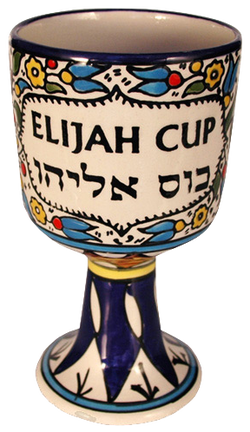
The large cup of wine that sits in the middle of our seder table is not called "Elijah's Cup," as many suppose, because the prophet will silently and invisibly come drink from it during the seder. Its meaning is far deeper than that. On an evening when we drink four cups of wine to represent the four promises that God made to the Israelites, Elijah's Cup is the fifth cup. It is the cup from which we cannot yet drink because the promise has not yet been fulfilled.
What is that promise? It is that "the hearts of the parents will turn toward the children, and the hearts of the children will turn toward their parents." The coming redemption, the great one that we still await, is that there will be reconciliation between generations. The world will not be fully redeemed until older people, who think they have seen it all, identify with childhood's sense of wonder and are able to look at the world as the shining, new-in-every moment place that it is. The promise will not be fulfilled until children deeply appreciate the wisdom of a received tradition that instructs them in how to live a life of meaning and joy.
Is that all it takes? Yes. When the nations that have fought for generations are able to look at each other the way children look at each other, then we will be able to hold each others hands in peace. When children are taught to find love and joy in ancient traditions, not confinement and rebuke, then there will be an end to resentment and rebellion.
The message of Elijah the prophet, in the prophecy of Malachi and in the symbolism of the seder table, is that redemption will not be delivered to us from on high, rather, it is held in the human heart. When we open to each other and see each other for the beautiful, brand new, ancient and splendid beings that we are, that is when the final promised redemption will come.
May it be soon and in our days.
Other Posts on This Topic:
And After the Fire — a Still, Small Voice
Matzah and Chameitz
The most common explanation comes from the last verses of the special haftarah reading of this day. The prophet Malachi says, "Behold, I will send Elijah the prophet to you before the coming great and awesome day of Adonai. He shall turn the hearts of the parents to the children, and the hearts of the children to their parents, lest I come to strike the land with destruction" (Malachi 3:23-24). Traditionally, the first of these two verses is repeated after the last, so the reading in Hebrew ends with the words, "The coming great and awesome day of Adonai."
So, if this is the reason for the name of this Shabbat, we call it "great" because it reminds us that God's redemption is not yet complete and there is still a "great and awesome" day to come. On that day, Elijah the Prophet, the herald of redemption, will "turn the hearts of the parents to the children and the hearts of the children to their parents." What does that phrase mean?
Passover is a holiday that is all about redemption. We remember how God redeemed Israel from slavery in Egypt. Yet, in the Haggadah, the rabbis constantly emphasize that the redemption we experienced at the Red Sea is only a provisional redemption. There is still an even greater redemption that we are waiting for – one in which the entire world will be redeemed. Based in part on the verse from this haftarah, the rabbis made Elijah the symbol of that promised and as-of-yet unfulfilled redemption.
The large cup of wine that sits in the middle of our seder table is not called "Elijah's Cup," as many suppose, because the prophet will silently and invisibly come drink from it during the seder. Its meaning is far deeper than that. On an evening when we drink four cups of wine to represent the four promises that God made to the Israelites, Elijah's Cup is the fifth cup. It is the cup from which we cannot yet drink because the promise has not yet been fulfilled.
What is that promise? It is that "the hearts of the parents will turn toward the children, and the hearts of the children will turn toward their parents." The coming redemption, the great one that we still await, is that there will be reconciliation between generations. The world will not be fully redeemed until older people, who think they have seen it all, identify with childhood's sense of wonder and are able to look at the world as the shining, new-in-every moment place that it is. The promise will not be fulfilled until children deeply appreciate the wisdom of a received tradition that instructs them in how to live a life of meaning and joy.
Is that all it takes? Yes. When the nations that have fought for generations are able to look at each other the way children look at each other, then we will be able to hold each others hands in peace. When children are taught to find love and joy in ancient traditions, not confinement and rebuke, then there will be an end to resentment and rebellion.
The message of Elijah the prophet, in the prophecy of Malachi and in the symbolism of the seder table, is that redemption will not be delivered to us from on high, rather, it is held in the human heart. When we open to each other and see each other for the beautiful, brand new, ancient and splendid beings that we are, that is when the final promised redemption will come.
May it be soon and in our days.
Other Posts on This Topic:
And After the Fire — a Still, Small Voice
Matzah and Chameitz
 RSS Feed