
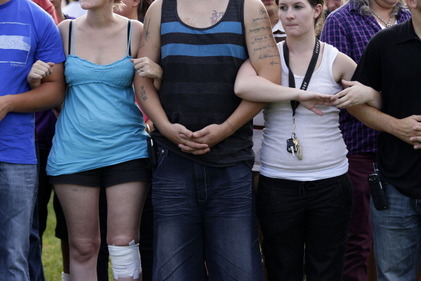
 Students at the University of Missouri form a human wall to block anti-gay protestors.
 This is what a revolution looks like. Consider the events of this month:
• On February 9, Michael Sam, a recently graduated football player from the University of Missouri, publicly announced that he is gay. It is expected that, once he signs with a professional team, he will be the first active NFL player to have declared publicly that he is gay. Less than a week after the announcement, hundreds of student at the University of Missouri formed a human wall to protect Sam from fifteen protestors from a radically anti-gay church.
• On February 12, Federal District Judge John G. Heyburn II ruled that, in keeping with the U.S. Constitution's guarantees of equal protection and due process, the state of Kentucky must recognize same-sex marriages performed in other states. The ruling did not, however, require the state to issue marriage licenses to same-sex couples.
• On February 13, Federal District Judge Arenda Wright Allen declared that the state of Virginia's ban on same-sex marriage is unconstitutional. The ruling was stayed pending appeal, meaning that same-sex couples will not be able to marry in Virginia until the state has exhausted its appeals to higher courts. Judge Wright Allen's ruling followed similar rulings by federal judges invalidating bans against same-sex marriages in Utah and Ohio.
• On February 23, professional basketball player Jason Collins signed with the New Jersey Nets and became first publicly gay athlete to play in any of four major North American pro sports leagues.
• Today, February 26, Federal District Judge Orlando Garcia ruled that the state of Texas' ban on same-sex marriage violates the U.S. Constitution. As in the Virginia case, the judge stayed the ruling pending appeal.
• Later today, February 26, Arizona Governor Jan Brewer, a conservative Republican, vetoed a measure that would have allowed businesses in the state to deny service to gay and lesbian customers on "religious grounds." Brewer had been urged to veto the bill by former conservative Republican presidential candidates Sen. John McCain and Mitt Romney. Brewer also had been pressured to reject the measure by business interests, including the National Football League. In a public pronouncement against the bill, Major League Baseball invoked the memory of Jackie Robinson and the struggle for African-American civil rights in the 1950s and '60s.
These events are stunning, but not just because they mark a dramatic turnaround in the way gays and lesbians are perceived and treated in our society. They are even more stunning because they are being accepted as almost inevitable developments by the majority of Americans. There are (as of yet) no big protest marches through the streets of deep red Oklahoma, Utah and Texas against these rulings. The few people who have spoken against the appearance of gay athletes in professional team sports have been roundly criticized for doing so. Even socially conservative political leaders recognize that laws permitting discrimination against gays and lesbians will eventually hurt them — badly — in public opinion.
Piece by piece, the attitudes of the American people toward gays and lesbians have been rebuilt over the course of the past decade. Back in 2003, before the Massachusetts Supreme Judicial Court ruled in favor of equal marriage rights, the idea of legalized marriage for same-sex couples seemed like a far-away dream of the gay activist fringe. The idea of openly gay men playing on professional sports teams seamed unthinkable.
ּA decade ago, nothing would have seemed odd or unforeseeable if business owners refused to serve people just because they were gay. Now, no one is dismayed when such discrimination is seen by many as a sign of bigotry. No one can claim to be surprised, either, if it is regarded as immoral and illegal.
We Americans were once persuaded by people who claimed that gays in sports or in the military would "threaten morale." We were frightened by people who preached that homosexuals had an agenda to "turn our loved ones gay." To most people, those claims now seem ridiculous, even delusional.
How did this change happen? How did the acceptance of gays and lesbians — something that once seemed like a distant hope and dream — become real? Mostly, it was built on broken closet doors. As more and more gays and lesbians began living their lives proud and out, the rest of society could not help but notice that they were real people with real lives, real problems, real love, and real pain. We also started to notice that they were our friends, our co-workers, our coreligionists, our aunts and uncles, our nieces and nephews, our sons, our daughter, and, sometimes, ourselves.
Piece by piece, those relationships built a new set of norms, new compassion, and a new sense of regret for previous attitudes. The revolution we have witnessed has been advanced by the melting away of old fears and the opening of hearts.
In this week's Torah portion (Pekudei), we see the culmination of the building of the Mishkan, the portable Tabernacle that the Israelites carried through the wilderness to worship God. The Mishkan was built piece by piece with excruciating detail, and with deepest devotion and caring. When all that labor of love finally came together — when Moses put together the final pieces — God's Presence descended upon the Israelites and found a home in the Mishkan.
That is my metaphor for this week. The love and compassion that our society has slowly put together over the last decade, one relationship at a time, seems to be culminating in a new and palpable presence that fills the vast majority of our society. May it ever be so.
Mind you, I am not declaring an end to this revolution. Not by a long shot. Every revolution has a counter-revolution, so don't be surprised when the forces that oppose equality gather their strength and push back hard against the changes they see in our society. There are signs already that this will happen.
Not all the news this month has been good. The Winter Olympics in Putin's Russia, with its arcane and draconian laws against "homosexual propaganda," were a reminder of how a society can be mired in ignorance and hatred. The passage of a law in Uganda that makes homosexuality a crime punishable by life imprisonment — a law that was passed with funding from American anti-gay activists — is another bitter reminder. So is the ongoing stream of news about violence against homosexuals right here in the United States.
And let's not forget that there are still 33 states in which not everyone has the right to marry the person they love. We have come a long way, but the task is not yet complete.
This revolution is not over, but the terms of the confrontation have changed. We no longer need to prove the obvious — that gays and lesbians are human beings and that their love has the same dignity and meaning as the love of straight people. With each victory in the courts, at the ballot box, in corporate policies, on college campuses, on the sporting field, around dining room tables, and under the chuppah, we are building a Tabernacle in which God's presence can be experienced.
Other Posts on This Topic:
Pinchas: Freedom Must be Won
Searching for How the Bible Defines Marriage
• On February 9, Michael Sam, a recently graduated football player from the University of Missouri, publicly announced that he is gay. It is expected that, once he signs with a professional team, he will be the first active NFL player to have declared publicly that he is gay. Less than a week after the announcement, hundreds of student at the University of Missouri formed a human wall to protect Sam from fifteen protestors from a radically anti-gay church.
• On February 12, Federal District Judge John G. Heyburn II ruled that, in keeping with the U.S. Constitution's guarantees of equal protection and due process, the state of Kentucky must recognize same-sex marriages performed in other states. The ruling did not, however, require the state to issue marriage licenses to same-sex couples.
• On February 13, Federal District Judge Arenda Wright Allen declared that the state of Virginia's ban on same-sex marriage is unconstitutional. The ruling was stayed pending appeal, meaning that same-sex couples will not be able to marry in Virginia until the state has exhausted its appeals to higher courts. Judge Wright Allen's ruling followed similar rulings by federal judges invalidating bans against same-sex marriages in Utah and Ohio.
• On February 23, professional basketball player Jason Collins signed with the New Jersey Nets and became first publicly gay athlete to play in any of four major North American pro sports leagues.
• Today, February 26, Federal District Judge Orlando Garcia ruled that the state of Texas' ban on same-sex marriage violates the U.S. Constitution. As in the Virginia case, the judge stayed the ruling pending appeal.
• Later today, February 26, Arizona Governor Jan Brewer, a conservative Republican, vetoed a measure that would have allowed businesses in the state to deny service to gay and lesbian customers on "religious grounds." Brewer had been urged to veto the bill by former conservative Republican presidential candidates Sen. John McCain and Mitt Romney. Brewer also had been pressured to reject the measure by business interests, including the National Football League. In a public pronouncement against the bill, Major League Baseball invoked the memory of Jackie Robinson and the struggle for African-American civil rights in the 1950s and '60s.
These events are stunning, but not just because they mark a dramatic turnaround in the way gays and lesbians are perceived and treated in our society. They are even more stunning because they are being accepted as almost inevitable developments by the majority of Americans. There are (as of yet) no big protest marches through the streets of deep red Oklahoma, Utah and Texas against these rulings. The few people who have spoken against the appearance of gay athletes in professional team sports have been roundly criticized for doing so. Even socially conservative political leaders recognize that laws permitting discrimination against gays and lesbians will eventually hurt them — badly — in public opinion.
Piece by piece, the attitudes of the American people toward gays and lesbians have been rebuilt over the course of the past decade. Back in 2003, before the Massachusetts Supreme Judicial Court ruled in favor of equal marriage rights, the idea of legalized marriage for same-sex couples seemed like a far-away dream of the gay activist fringe. The idea of openly gay men playing on professional sports teams seamed unthinkable.
ּA decade ago, nothing would have seemed odd or unforeseeable if business owners refused to serve people just because they were gay. Now, no one is dismayed when such discrimination is seen by many as a sign of bigotry. No one can claim to be surprised, either, if it is regarded as immoral and illegal.
We Americans were once persuaded by people who claimed that gays in sports or in the military would "threaten morale." We were frightened by people who preached that homosexuals had an agenda to "turn our loved ones gay." To most people, those claims now seem ridiculous, even delusional.
How did this change happen? How did the acceptance of gays and lesbians — something that once seemed like a distant hope and dream — become real? Mostly, it was built on broken closet doors. As more and more gays and lesbians began living their lives proud and out, the rest of society could not help but notice that they were real people with real lives, real problems, real love, and real pain. We also started to notice that they were our friends, our co-workers, our coreligionists, our aunts and uncles, our nieces and nephews, our sons, our daughter, and, sometimes, ourselves.
Piece by piece, those relationships built a new set of norms, new compassion, and a new sense of regret for previous attitudes. The revolution we have witnessed has been advanced by the melting away of old fears and the opening of hearts.
In this week's Torah portion (Pekudei), we see the culmination of the building of the Mishkan, the portable Tabernacle that the Israelites carried through the wilderness to worship God. The Mishkan was built piece by piece with excruciating detail, and with deepest devotion and caring. When all that labor of love finally came together — when Moses put together the final pieces — God's Presence descended upon the Israelites and found a home in the Mishkan.
That is my metaphor for this week. The love and compassion that our society has slowly put together over the last decade, one relationship at a time, seems to be culminating in a new and palpable presence that fills the vast majority of our society. May it ever be so.
Mind you, I am not declaring an end to this revolution. Not by a long shot. Every revolution has a counter-revolution, so don't be surprised when the forces that oppose equality gather their strength and push back hard against the changes they see in our society. There are signs already that this will happen.
Not all the news this month has been good. The Winter Olympics in Putin's Russia, with its arcane and draconian laws against "homosexual propaganda," were a reminder of how a society can be mired in ignorance and hatred. The passage of a law in Uganda that makes homosexuality a crime punishable by life imprisonment — a law that was passed with funding from American anti-gay activists — is another bitter reminder. So is the ongoing stream of news about violence against homosexuals right here in the United States.
And let's not forget that there are still 33 states in which not everyone has the right to marry the person they love. We have come a long way, but the task is not yet complete.
This revolution is not over, but the terms of the confrontation have changed. We no longer need to prove the obvious — that gays and lesbians are human beings and that their love has the same dignity and meaning as the love of straight people. With each victory in the courts, at the ballot box, in corporate policies, on college campuses, on the sporting field, around dining room tables, and under the chuppah, we are building a Tabernacle in which God's presence can be experienced.
Other Posts on This Topic:
Pinchas: Freedom Must be Won
Searching for How the Bible Defines Marriage

 RSS Feed