
This week's Torah portion (Yitro) tells the dramatic story of the giving of the Ten Commandments on Mount Sinai. The story is filled with thunder, lightening and blaring horns as God's words are heard by the Israelites. Yet, after all the drama, the Torah portion concludes with a brief and quiet epilogue in which God follows up on the Ten Commandments with a few more laws for the building of the altar. Among the laws is an unexpected instruction:
"And if you make for Me an altar, you shall not build it of hewn stones, for by wielding your sword upon it you shall profane it." –Exodus 20:22
There is no further explanation as to why cutting the stones would profane the altar. In fact, this prohibition against hewn stones appears to contradict other biblical passages that describe the cutting of stones for Solomon's Temple (see I Kings 6:7 and I Chronicles 22:2). So, why does Exodus say that the stones of the altar could not be hewn?
The sages of the Mishnah offer an explanation that seems to be more symbolic than historical. They teach, "It is because iron was created to shorten a person's life, and the altar was created to lengthen a person's life. It is not fitting that something that shortens life should be waved over that which lengthens life" (M. Middot 3:4).
The rabbis focussed on the word "sword" in the verse from Exodus and concluded that iron tools should not be used to cut the stones of the altar because such tools were associated with the weapons of violence and warfare. The purpose of the altar was to draw people close to the God of life through sacrificial offerings. (The Hebrew word for sacrifice, korban, comes from the root that means "to come close.") Swords and altars served opposite purposes: one takes life and one gives life. The two needed to be kept separate.
In our own time, we might have difficulty understanding how an altar where animals are brought to be slaughtered and burned can be a symbol of life. However, in the world of the Bible, the association was natural.
The ancient Israelites were shepherds and herders. The animals they raised were, literally, the source and support of their lives. They recognized that the birth of every animal was a miracle that could mean the difference between their own life and death. Expressing gratitude to God by returning a portion of their herds and flocks to God was a way to acknowledging that miracle.
For the ancients, the association between iron weapons and death was real, not just an abstraction. In a world without police departments, prisons, or home security systems, a sword in the wrong hands could bring death very quickly. Warfare was a much more frequent reality than we experience today, and every able-bodied male was expected to do his part by taking up a sword in a time of war.
What does this teaching mean for our times? We, too, have a need to identify and keep separate our celebrations of life and the tools we use to bring death. Like the ancients, we do not want to inadvertently place our sacred offerings on an altar of death.
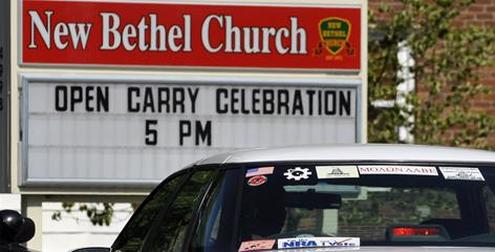
In America today, there is a fascination with firearms. In Florida, where I used to serve as a rabbi, it is not uncommon for churches to sponsor events promoting gun ownership and sermons encouraging parishioners to arm themselves. Despite the 30,000+ gun-related deaths that occur every year in the United States, Congress this week voted to block a federal regulation that would keep guns out of the hands of people with serious mental illnesses.
Even in Rhode Island, where I now serve, I have testified before the state General Assembly on gun safety laws, only to hear opponents of those laws testify with bizarre conspiracy theories about how the government will use such laws to disarm the public and establish a police state. The cult of the gun has become almost a religion unto itself.
Have we built ourselves an altar of weapons? Have we confused the source of life with a source of death? The Torah does not deny the need for the sword in a dangerous world. However, it does want us to be careful not to worship our weapons. There is a need for our society to listen and to distinguish between life and death.
Other Posts on This Topic:
Guns and Talmud
Darkness
"And if you make for Me an altar, you shall not build it of hewn stones, for by wielding your sword upon it you shall profane it." –Exodus 20:22
There is no further explanation as to why cutting the stones would profane the altar. In fact, this prohibition against hewn stones appears to contradict other biblical passages that describe the cutting of stones for Solomon's Temple (see I Kings 6:7 and I Chronicles 22:2). So, why does Exodus say that the stones of the altar could not be hewn?
The sages of the Mishnah offer an explanation that seems to be more symbolic than historical. They teach, "It is because iron was created to shorten a person's life, and the altar was created to lengthen a person's life. It is not fitting that something that shortens life should be waved over that which lengthens life" (M. Middot 3:4).
The rabbis focussed on the word "sword" in the verse from Exodus and concluded that iron tools should not be used to cut the stones of the altar because such tools were associated with the weapons of violence and warfare. The purpose of the altar was to draw people close to the God of life through sacrificial offerings. (The Hebrew word for sacrifice, korban, comes from the root that means "to come close.") Swords and altars served opposite purposes: one takes life and one gives life. The two needed to be kept separate.
In our own time, we might have difficulty understanding how an altar where animals are brought to be slaughtered and burned can be a symbol of life. However, in the world of the Bible, the association was natural.
The ancient Israelites were shepherds and herders. The animals they raised were, literally, the source and support of their lives. They recognized that the birth of every animal was a miracle that could mean the difference between their own life and death. Expressing gratitude to God by returning a portion of their herds and flocks to God was a way to acknowledging that miracle.
For the ancients, the association between iron weapons and death was real, not just an abstraction. In a world without police departments, prisons, or home security systems, a sword in the wrong hands could bring death very quickly. Warfare was a much more frequent reality than we experience today, and every able-bodied male was expected to do his part by taking up a sword in a time of war.
What does this teaching mean for our times? We, too, have a need to identify and keep separate our celebrations of life and the tools we use to bring death. Like the ancients, we do not want to inadvertently place our sacred offerings on an altar of death.
In America today, there is a fascination with firearms. In Florida, where I used to serve as a rabbi, it is not uncommon for churches to sponsor events promoting gun ownership and sermons encouraging parishioners to arm themselves. Despite the 30,000+ gun-related deaths that occur every year in the United States, Congress this week voted to block a federal regulation that would keep guns out of the hands of people with serious mental illnesses.
Even in Rhode Island, where I now serve, I have testified before the state General Assembly on gun safety laws, only to hear opponents of those laws testify with bizarre conspiracy theories about how the government will use such laws to disarm the public and establish a police state. The cult of the gun has become almost a religion unto itself.
Have we built ourselves an altar of weapons? Have we confused the source of life with a source of death? The Torah does not deny the need for the sword in a dangerous world. However, it does want us to be careful not to worship our weapons. There is a need for our society to listen and to distinguish between life and death.
Other Posts on This Topic:
Guns and Talmud
Darkness


 RSS Feed