
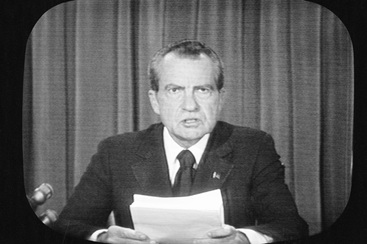
Thirty-nine years ago tonight, I was an eleven-year-old kid at summer camp. The camp director rang a bell heard across campus telling all campers to gather in the recreation hall. We had no idea why.
When we took our seats, one row for each cabin, we saw that a television had been set up on the stage for us to watch. On that black and white television, I watched the President of the United States announce that he would resign his office as of noon the following day.
Richard Nixon became the only U.S. President ever to resign. He had been caught covering up a break-in, ordered by the White House, at the Democratic National Committee headquarters. Nixon would later justify the break-in and the cover-up by saying, "If the President does it, that means it’s not illegal." In the end, Nixon was destroyed by his belief that his will as the elected President was superior to the law and the Constitution. He believe that he was above the law. Nixon thus became democracy's worst nightmare.
Oddly enough, it is a nightmare that is anticipated in this week's Torah portion (Shoftim). Moses warned the Israelites that, in the future, if they wanted to have a king, they should be very careful that he not be allowed to accumulate too much military power or wealth, and that he always should accept in humility the law of the Torah as his guide:
When we took our seats, one row for each cabin, we saw that a television had been set up on the stage for us to watch. On that black and white television, I watched the President of the United States announce that he would resign his office as of noon the following day.
Richard Nixon became the only U.S. President ever to resign. He had been caught covering up a break-in, ordered by the White House, at the Democratic National Committee headquarters. Nixon would later justify the break-in and the cover-up by saying, "If the President does it, that means it’s not illegal." In the end, Nixon was destroyed by his belief that his will as the elected President was superior to the law and the Constitution. He believe that he was above the law. Nixon thus became democracy's worst nightmare.
Oddly enough, it is a nightmare that is anticipated in this week's Torah portion (Shoftim). Moses warned the Israelites that, in the future, if they wanted to have a king, they should be very careful that he not be allowed to accumulate too much military power or wealth, and that he always should accept in humility the law of the Torah as his guide:
You shall be free to set a king over yourself… He shall not keep many horses … nor shall he amass silver and gold to excess. When he is seated on his royal throne, he shall have a copy of this Torah written for him on a scroll by the levitical priests. Let it remain with him and let him read in it all his life, so that he may learn to revere Adonai his God, to observe faithfully every word of this Torah as well as these laws. Thus he will not act haughtily toward his fellows or deviate from the commandments to the right or to the left, so that he and his descendants may reign long in the midst of Israel. (Deuteronomy 17:15-20)
Nixon, and those who aided him in abrogating the law and the Constitution, were exactly the kinds of leaders that Moses wanted to warn us about. They believed that their election meant there was nothing that stood above them or that could limit their power. There was no Torah — no authority higher than their own desires — that they would keep as a touchstone to determine whether their actions were right and just. Their arrogance led them to believe they were limitless.
I'm not sure what America has learned from the disaster of the Nixon presidency that ended thirty-nine years ago today. Since then, we have seen other Presidents who have usurped power. We have learned that we need to be skeptical of our leaders and we have learned to expect the worst from politicians. However, I don't think we have learned the central truth of Moses' teaching — that great power requires great humility, and that real leaders set aside their own interests in order to pursue a higher truth.
We have been warned.
Other Posts on This Topic:
Vayikra: The Joy of Contrition
Nurturing and Caring for Your Inner Korach
I'm not sure what America has learned from the disaster of the Nixon presidency that ended thirty-nine years ago today. Since then, we have seen other Presidents who have usurped power. We have learned that we need to be skeptical of our leaders and we have learned to expect the worst from politicians. However, I don't think we have learned the central truth of Moses' teaching — that great power requires great humility, and that real leaders set aside their own interests in order to pursue a higher truth.
We have been warned.
Other Posts on This Topic:
Vayikra: The Joy of Contrition
Nurturing and Caring for Your Inner Korach


 RSS Feed