
I will openly and joyfully admit this truth about myself: I am a nerd.
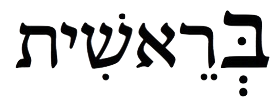
By "nerd," I mean that I delight in the meticulous details of a subject that most people find irrelevant, uninteresting or boring. Some people are science fiction nerds who think that it is crucially important whether it was Han Solo or Greedo who shot first, while the rest of us shrug our shoulders. I am a Hebrew grammar nerd who thinks it is important whether the first letter of the Torah has the vowel kamatz or a sh'va underneath it. By the end of this post, I hope that you will think that it is important, too.
So, let us start this story at the beginning. The first three words of the Torah are, "בראשית ברא אלהים" (B'reishit bara Elohim), which is often translated as, "In the beginning, God created..." That is the way that the phrase is translated in the King James Version of the Bible and in most other versions and translations. On the whole, it is not a bad way of putting it into English. However, this translation fails to convey a stunning fact about Hebrew grammar and the Bible. The very first verse of the Bible, the very first word, and the very first letter, contains what may be called a grammatical "mistake."
One thousand years ago, the great commentator, Rabbi Shlomo Yitzchaki (known as Rashi), observed that the word b'reishit cannot be explained grammatically in this verse. The vowel called "sh'va" is under the letter bet in the word b'reishit, which means that the word must be in the "construct state" (s'michut). This is the form of a noun that is the first part of a noun-noun pair. (We have noun-noun pairs in English, too, in words and phrases like "doorknob," "dining room" and "house-builder." However, in Hebrew, unlike English, there are complicated grammatical rules for creating such pairs.) Because the word b'reishit is in the construct state, it should be translated as "In the beginning of." If the text had wanted to say "In the beginning, God created," there would have been a simple way of saying that by changing the sh'va to a kamatz —"bareishit" instead of "b'reishit."
Rashi points out that in every other place in the Hebrew Bible that contains the word b'reishit (there are four more of them) the word clearly has this meaning. For example, in Jeremiah 26:1 we read, "B'reishit mamlechut Yehoyakim," "In the beginning of the kingdom of Jehoiakim." The form of the word b'reishit can only mean "in the beginning of...," and the word that follows it should be a noun that answers the question, "in the beginning of what?"
The problem—from a grammatical point of view—is that the word following b'reishit in Genesis 1:1 is not a noun. The next word is bara, a verb that means, "He created." A word-by-word translation of the whole phrase, b'reishit bara Elohim, would have to be something like: "In the beginning of God created." Obviously, that is not going to work as a translation into English because it doesn't make any sense in English.
How do we understand, then, the first three words of the Hebrew Bible? Why does the Bible begin with a phrase that is such an untranslatable, ungrammatical mess? Obviously, it is not just a "mistake." The unusual grammar of the first word of the Bible must have some intentional significance.
When did God create the world? It was in the beginning of God created the world. The tautology makes no grammatical sense or temporal sense, but it makes great spiritual sense. The world was created, but it never stopped being created. The world has a beginning, but it is a beginning that has never ceased.
The Torah begins by telling us that it does not exist in time the way other stories do. It exists in a suspended moment that cannot be pinpointed on a timeline. The difference between two little dots, or a little "T" shape, under that great big bet is the difference between a Torah that tells a conventional story and a Torah that tells a story that exists outside of time and within all time.
"B'reishit bara Elohim." In the beginning of the beginning that is always beginning, God created the creation that is still.
By "nerd," I mean that I delight in the meticulous details of a subject that most people find irrelevant, uninteresting or boring. Some people are science fiction nerds who think that it is crucially important whether it was Han Solo or Greedo who shot first, while the rest of us shrug our shoulders. I am a Hebrew grammar nerd who thinks it is important whether the first letter of the Torah has the vowel kamatz or a sh'va underneath it. By the end of this post, I hope that you will think that it is important, too.
So, let us start this story at the beginning. The first three words of the Torah are, "בראשית ברא אלהים" (B'reishit bara Elohim), which is often translated as, "In the beginning, God created..." That is the way that the phrase is translated in the King James Version of the Bible and in most other versions and translations. On the whole, it is not a bad way of putting it into English. However, this translation fails to convey a stunning fact about Hebrew grammar and the Bible. The very first verse of the Bible, the very first word, and the very first letter, contains what may be called a grammatical "mistake."
One thousand years ago, the great commentator, Rabbi Shlomo Yitzchaki (known as Rashi), observed that the word b'reishit cannot be explained grammatically in this verse. The vowel called "sh'va" is under the letter bet in the word b'reishit, which means that the word must be in the "construct state" (s'michut). This is the form of a noun that is the first part of a noun-noun pair. (We have noun-noun pairs in English, too, in words and phrases like "doorknob," "dining room" and "house-builder." However, in Hebrew, unlike English, there are complicated grammatical rules for creating such pairs.) Because the word b'reishit is in the construct state, it should be translated as "In the beginning of." If the text had wanted to say "In the beginning, God created," there would have been a simple way of saying that by changing the sh'va to a kamatz —"bareishit" instead of "b'reishit."
Rashi points out that in every other place in the Hebrew Bible that contains the word b'reishit (there are four more of them) the word clearly has this meaning. For example, in Jeremiah 26:1 we read, "B'reishit mamlechut Yehoyakim," "In the beginning of the kingdom of Jehoiakim." The form of the word b'reishit can only mean "in the beginning of...," and the word that follows it should be a noun that answers the question, "in the beginning of what?"
The problem—from a grammatical point of view—is that the word following b'reishit in Genesis 1:1 is not a noun. The next word is bara, a verb that means, "He created." A word-by-word translation of the whole phrase, b'reishit bara Elohim, would have to be something like: "In the beginning of God created." Obviously, that is not going to work as a translation into English because it doesn't make any sense in English.
How do we understand, then, the first three words of the Hebrew Bible? Why does the Bible begin with a phrase that is such an untranslatable, ungrammatical mess? Obviously, it is not just a "mistake." The unusual grammar of the first word of the Bible must have some intentional significance.
When did God create the world? It was in the beginning of God created the world. The tautology makes no grammatical sense or temporal sense, but it makes great spiritual sense. The world was created, but it never stopped being created. The world has a beginning, but it is a beginning that has never ceased.
The Torah begins by telling us that it does not exist in time the way other stories do. It exists in a suspended moment that cannot be pinpointed on a timeline. The difference between two little dots, or a little "T" shape, under that great big bet is the difference between a Torah that tells a conventional story and a Torah that tells a story that exists outside of time and within all time.
"B'reishit bara Elohim." In the beginning of the beginning that is always beginning, God created the creation that is still.
 RSS Feed