Reb Jeff
  • Blog
  • About
  • Favorites
  • Resources
    • Counting of the Omer
  • Wedding Officiation
  • Contact Me
  • Temple Sinai

Sleep Deprived Thoughts on the Way to Israel

12/20/2012

 
Today I'm traveling with my family to Israel, my children's first trip ever to the home of the Jewish people. It is also my first trip in some sixteen years. 

I'm embarrassed by how long it has taken me to return, for it is a place that is so important to me. Any length of time spent away seems like it must be a mistake.
Picture
Photo: Marco Zeininger
I'm 30,000 miles above Western Europe (France now, I think) and I'm sitting next to my fourteen-year-old daughter, who, like me, has barely slept. That's probably a mistake considering the massive jet let we will have. But I just can't seem to sleep on planes, and this sleepless flight has really got my mind wandering over this journey and its destination. 

I often remind American Jews that Israel is a real place, not the make-believe land that they sometimes imagine. It is neither the dangerous place of unending warfare they see on television, nor is it the place where people sleepwalk in constant reverie of their prophetic ancestors. Israel has more than its share of problems, to be sure, but it is a place like any other—complete with traffic congestion, petty crime, and painful disparities between rich and poor. It may be a land founded on a dream, but its present realities can be rather mundane.

Except for this…Israel just happens to be our place, the place of our people. It's the place where the Jewish heart lies and where our identity as a people began. It is where we discover what it means to create a truly Jewish society and the real-world challenges of living up to Jewish values. By pulling Judaism into the world of the here-and-now, Israel forces Judaism to reach even higher to realize its dreams.

I recognize that I, too, am not immune to the bug of creating an Israel of the imagination. Traveling by way of the lofty sky, I realize that I also dream my Israel fictions. I keep thinking about wanting to relive experiences from my first year of rabbinic school in Israel. I think about showing my children those special places and watching them discover them to be their own. Such thoughts along the journey are for clouds. I'd like to arrive on the ground at some point upon reaching my destination. 

I'll do the best I can to keep a journal of my trip on this blog. I want to share with you both Israels— the timeless dream and the gritty reality. Really loving Israel, I think, means staying true to both. The Jewish people and the Land of Israel are, I think, like an old couple who love each other deeply through the memory of the days when love was new, and who love each other even more deeply when they see each other for who they are now. That is how I want to teach my children to love Israel.
Darkness

12/14/2012

 
I got a press call today. I suspect that many rabbis and other clergy members across the country got the same call. The newspaper reporter on the other end of the line did her job by dutifully asking the question, "Rabbi, what are you going to say to your congregation about today's events?"
Picture
How should I answer? What words of wisdom can possibly be offered about a man who would enter a kindergarten classroom and murder little children? Is there a way to make any sense of it at all? 

How I will cling to my children tonight! How I will cry out in pain for those lost little ones in Connecticut and for their families!

To make matters worse, tonight is the seventh night of Chanukah. We are near the climax of our holiday that celebrates increasing the light. Today's events are all darkness—a pit of swirling, unending darkness. 

Our tradition tells us that we are obliged to defy darkness. It is our duty not to give in to despair, but to insist that we are sustained by hope. We must rail against the fatalism that says that there is nothing we can do. We must dedicate ourselves to declaring that the world can be—must be—better.
"Never despair! Never! It is forbidden to give up hope!"
—Rabbi Nachman of Bratslav, Likutei Moharan II:78
The reporter on the other end of the phone line took down my words as best she could. Tomorrow, maybe, they will be in the paper. And the day after that they will be in the recycling bin. But something from this experience—by God—has got to last longer than that. 

Today is not the day, but tomorrow surely will be, to say that there are things that we can do—must do—to stop events like this from happening again. Our governments, state and federal, can take action. Our communities can take action. Our schools and families can take action. Each one of us as individuals can do something. We have an obligation to rail against the darkness, to increase the light where there is despair.

My Chanukah plea to you is this: Be part of the light. Call your Congressmen and Senators on Monday morning and tell them how you feel about gun control. Show up at the next school board meeting and make your voice heard about emergency preparedness. Get in touch with your local police department and talk with them about how to prevent violence in your community. Support organizations that advocate effective treatment for mental illness and provide support for the families of people who are mentally ill. 

Do something. That has always been the Jewish response to despair. Confront the darkness.

The Shamash is the Tall One in the Middle

12/13/2012

 
"You're gonna have to serve somebody,
You're gonna have to serve somebody,
Well, it may be the devil or it may be the Lord
But you're gonna have to serve somebody."

—Bob Dylan
On the day I was ordained by my rabbinic school, one of my teachers left me a note congratulating me on my new role in life, "To serve the servants of the Most High." The phrase has stayed with me as a sacred intention for my work. To be a rabbi is to be a servant.
Picture
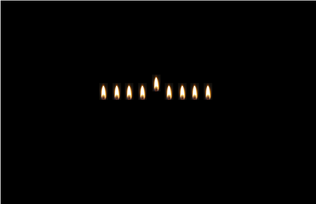
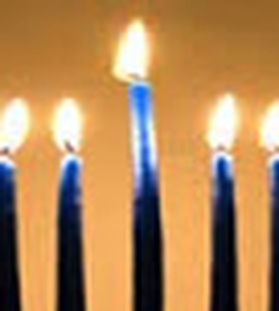
There is a nice metaphor for the work of a rabbi right there in the middle of a Chanukah menorah. The central candle, the one that is used to light the others, is called the shamash. It is a Hebrew word that means, "servant." 

According to rabbinic tradition, the eight lower lights of the Chanukah menorah are holy. They may only be used for gazing upon them in remembrance of the miracle of Chanukah. The traditional formula recited after the candle lighting says, "We have no right to use them apart from looking at them." 

The original purpose of the shamash was not to light the other candles. Rather, the shamash provides the ordinary light that can be used for ordinary purposes. When people read a book or walk across an otherwise darkened room by the light of the Chanukah menorah, we say that they are using the light of the shamash. The only holiness that belongs to the shamash comes from the way it allows the other candles to be holy.

Likewise, the holiness of a rabbi is only in his or her being useful for drawing out the holiness of others. A rabbi is a servant, not a holy figure to be venerated above others. Without a Jewish community to reflect the light of Torah, a rabbi would be just an ordinary candle. 

People often look at rabbis as the people in the community who are supposed to be "in charge." After all, there they are in the most visible role, right in the middle of everything. But rabbis are just like that shamash—center-stage and high on a platform, but only as a servant to those who stand on either side. The men, women and children who come to learn, to pray, and to make a difference in the community are the real life of the congregation. They are the holy ones. The rabbi is just the conduit, the organizer, the vehicle.

Joseph, in this week's Torah portion (Miketz), is called upon to interpret two dreams for Pharaoh. Pharaoh says to him, "I have heard it said that for you to hear a dream is to tell its meaning." Joseph, however, understands the truth of his role. He says, "Not I! It is God who will see to Pharaoh’s welfare" (Genesis 41:15-16). 

This is what rabbis do. Like Joseph, and like that tall candle in the middle, rabbis are best able to do their job by recognizing that it's not all about them. It's about the community; it's about the Torah; it's about God. It is about the flame the rabbi carries and those to whom the rabbi carries it.


Other Posts on This Topic:
The Blind and the Light
Ten Thoughts About Being a Congregational Rabbi
Miketz: Deception

The Latke Principles

12/11/2012

 
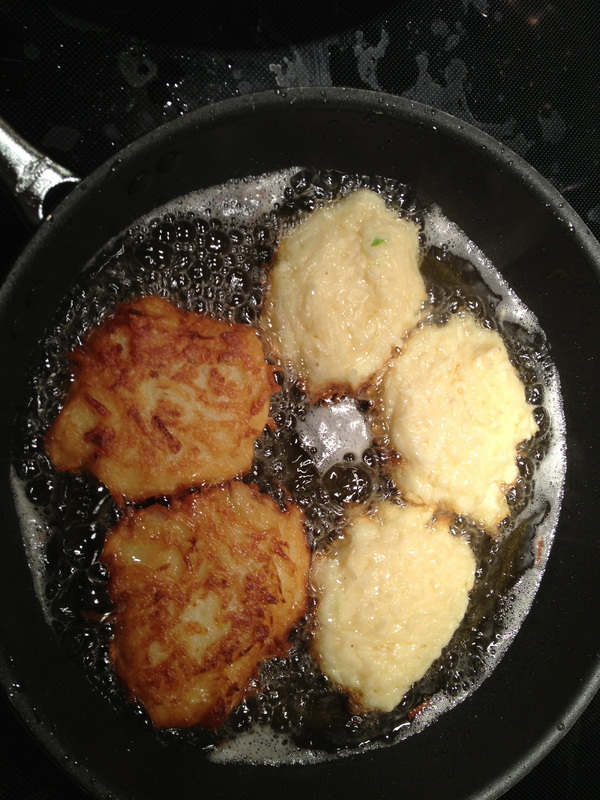
Pictured here are the latkes I made last night for my family. I find—somewhat absurdly—that I have strong opinions when it comes to latkes. Here are the latke principles for which I stand:

1) There is a popular translation of the Yiddish song, "Oy Chanukah," that refers to "Crispy little latkes, tasty and thin." This, I say, is an affront to what latkes are meant to be. Once you have eaten a thick and hearty potato latke, you should know that you have eaten something. The sweet and salty flavor should linger in your mouth while the substance of the pancake amply fills your belly. To call a latke "little," or, even worse, "thin," is to deny the essence of what latkes are all about. "Crispy" on the outside is fine, as long as it is balanced by "plump" or "juicy" on the inside.
Picture
2) In the great contest that pits applesauce versus sour cream, I proudly affirm that they are both winners. The only thing that could be wrong about either topping would be to put on so much that you cannot taste the latke itself. A latke that is merely a substrate for sweet applesauce or tangy sour cream is not worth eating. The latke must have flavor that you would savor without any topping at all. The topping is just a bonus.

3) I recently discovered a third excellent topping for latkes. (I know. I am breaking with tradition on this one. Call me a heretic.) When you mix together a cup of greek yogurt, a pair of crushed garlic cloves, and a quarter teaspoon of salt, you get this fabulous sauce that is just crying out to be spread on top of fried potatoes and onions. Try it. It will elevate your latke experience.

4) Remember that the latke became a staple food of Chanukah for one reason only—the oil. Eating a latke should vaguely remind you of the miracle of the oil that burned for eight days when it was supposed to burn for only one. (If the latke gives you heartburn, so much the better for remembering the burning lights of the ancient Temple Menorah). To create a latke-thing that is baked in an oven, or otherwise deprived of oil, is a sin against the memory of the Maccabees. Look, folks, Chanukah is only for eight days. You can lower your HDLs and LDLs in January. 

5) I've heard about Latke-Hamantaschen debates. Without casting any aspersions against the fine poppy-filled pastry of Purim, let me just say this: It's no contest. Eating a good latke is like receiving a glimpse of heaven. On Purim, I prefer the Slivovitz.

6) Texture makes a latke as much as flavor. A latke must not be made with potatoes that have all been irreparably reduced to mush. There needs to be bits of shredded (not grated) potato in the latke to give it the right feeling in your mouth. Run away from any potato ingredient that contains the words "reconstituted" or "powdered." Yuck.

7) Latkes are not deep fried. Deep frying is a technique for cooking food at high temperatures very quickly. If you do that to a latke, you will end up with something that is a lifeless, burnt, crumbly mess. Latkes are shallow fried. They cook slowly at lower temperatures while sitting in a puddle of oil. They are golden brown, savory and sweet. If you think you don't like latkes, it is because you've been eating the charred remains of perfectly good potatoes and onions.

8) Yes, I know about cheese latkes. I've read that they actually are the "original" latke. My wife makes incredible cheese latkes that are basically ricotta cheese fried in butter with a dollop of homemade rose hip jam on top. There is no part of the previous sentence that I do not like.

9) Of course, latkes are fattening. If you do not put on a few extra pounds during Chanukah, you are not doing it right. Just don't eat from the last day of Chanukah until Presidents Day and you'll be fine.

10) Any advice on what to do with leftover latkes is entirely missing the point.


Other Posts on This Topic:
Chanukah Chaiku
A Day of Chanukah

A Day of Chanukah

12/9/2012

 
Saturday, 6:10 p.m.
Chanukah begins for my family. We visit my parents' home in Palm Beach Gardens so the kids can celebrate the holiday with their grandparents. We light the menorah for the first time this year on their kitchen table and I am proud—oh, so proud—of my kids who recite the blessings beautifully, say "thank you" after receiving each gift, and give each grandparent a big hug with lots of kisses. We eat dinner, linger over good conversation, and drive home. It is a very successful beginning to the holiday. I am wondering if the third helping of latkes smothered with sour cream was a mistake. Probably.
Picture
Sunday, 7:00 a.m.
I wake up to find that my younger daughter is excited. Up to this point, I had not remembered just how excited she gets over Chanukah. She is bouncing on our bed, asking questions about plans for the day, anticipating presents, and contemplating craft projects. I am still in the bed, barely awake, wondering if I can make it to the shower. Success. After a quick breakfast, we round up the kids into my car to drive to Religious School. On the way, we stop at Dunkin' Donuts where I purchase a dozen jelly doughnuts from the drive-through. These will be the sufganiyot I will offer to the students in my Confirmation Class. Not for the last time, I wonder why Dunkin' Donuts does not market its jelly doughnuts as an exceptional Chanukah treat. Do they even know...?

Sunday, 9:30 a.m.
We have a family education event this morning for the sixth and seventh grades and there is a huge turn-out. Our theme for today is "Lashon HaRa," the prohibition in Jewish law against speaking ill of another person. There are fifty or so students and parents gathered in the Temple's social hall for the occasion. I start the program by acting out a famous chassidic story about a woman who goes to a rabbi seeking forgiveness for the sin of gossiping. The rabbi instructs her to tear open a feather pillow in the town market and release all the feathers. The woman is confused by the instructions, but does as the rabbi tells her. When she later returns to the rabbi to receive her forgiveness, he tells her that she must first go back to the market and collect all the feathers. The woman protests that it is impossible, but the rabbi teaches her that lashon hara is considered such a serious sin because, like the feathers from that pillow, it is impossible ever to take back words once they have been released to the winds. Good story. I then take the parents into the sanctuary while the cantor does a crafts project with the kids about lashon hara (with feathers) in the social hall. My lesson with the parents focusses on the positive character traits we want to teach our children and how to connect them to Jewish ethical teachings. 

Sunday, 10:30 a.m.
I start class with my eleven Confirmation students. The sufganiyot are a big hit. (No surprise there). I love teaching this class. The students are a diverse group, including loud kids and quiet kids, serious kids and fun-loving kids. However, they are all bright, kind, thoughtful and committed to being Jews. (That's not always a given in a community where there are only a handful of Jews in each public school grade.) Today, the lesson is on cheating, which I know will be a hot-button issue for a lot of these students. I'm not surprised that they are all-too-willing to share stories about cheating in their schools. Some even admit to having cheated themselves. (No names. What is said in the Confirmation class, stays in the Confirmation class.) We talk about the harm that cheating does to other students, to teachers, to schools, and, most of all, to the cheating students themselves. We talk about Jewish values of trust, truthfulness and fairness. We talk about the prohibition in Jewish law against deceiving others. They get it. There is still powdered sugar on their beautiful faces.

Sunday, 11:30 a.m.
During the service at the end of Religious School, I talk about Chanukah as a holiday that recalls miracles. I point out that the miracle of Chanukah—a story about a one-day supply of oil that lasted for eight days—does not seem like such a big deal. However, I tell them that many of life's miracles are easily overlooked. I ask the students to give me some examples. One child says that her brother just passed an exam to get into the Air Force Academy, and that is like a miracle for him. Another child says that the way her big sister loves her is the biggest miracle in her life. One child says that our congregation itself is a miracle. Don't I have a great job?

Sunday, 2:00 p.m.
Today we are showing one of the six films in this year's Treasure Coast Jewish Film Festival. Today's movie is Reuniting the Rubins, a comedy about a grandmother who manipulates her son into reuniting his children for a Passover seder. With my rabbinic colleagues from the other two Jewish congregations on the Treasure Coast, we introduce the film with our usual ritual of lighting a candle and reciting the blessing for the study of Torah (yes, there is Torah in watching contemporary Jewish films, if you look for it). I find the movie to be a bit silly and sentimental (also, the sound system doesn't work as well as it should). However, I see that The Rubins connects well with the 90 or so people who have come to see it. During the discussion that follows the film, people observe themes that are familiar to them—the difficulty of keeping families together in an age of geographic dispersion, Jewish mourning customs that seem anachronistic and moving at the same time, a Jewish community that is so diverse that it can be difficult to get Jews to agree on anything. I learn that there is meaning for people in a place where I mostly saw triviality. 

Sunday 5:45 p.m.
I come home tired from a long day of work. (I've been invited to two public menorah lightings this evening, but I'm not going to make it to either of them. It's too late and I'm too exhausted.) Yet, there is more work to be done. My two children are just as excited about Chanukah as they were this morning and they want more latkes. My wife starts a batch of potato latkes and I am enlisted to make the cheese latkes. The kids help and it is a huge production that takes over the kitchen and spreads into the living room. We set up the menorahs (our family lights several on each night of the holiday). We make the blessings, sing the songs, devour the meal, exchange gifts, sing some more, and frighten the dog with our clapping, hollering, and merrymaking. At one point, as the four of us are bound in a big family hug, with our four noggins bumping against each other, I am speechless with joy. My wife catches my eyes with hers and says one word: "This." 

I know exactly what "This" means. "This moment," she is saying silently, "is why we married each other seventeen years ago. This experience is what makes up for all the tough times, all the difficulties of raising children, all the hardships of a demanding job, all the conflicts that need to be resolved, and all the problems that just have to wait. This wonderful, blessed moment is what keeps us going, keeps us loving life and each other, keeps the fire in our souls burning from every yesterday until every tomorrow." I just gaze into her face and whisper back the single word in complete agreement: "This."

Chanukah is a minor holiday of little miracles. It is eight days of trying to notice the extraordinary that is concealed in the garments of the ordinary. A day's worth of oil burned for eight days? Who even notices a miracle like that? I'll tell you who. It is the same people who delight in hearing the squeals of an eight-year-old girl, the people who ponder how to raise a child to take pleasure in doing what is right, the people who understand that being part of a caring community is itself a miracle. It is people who deeply know the good that has been given to them just through the gesture of a hug, a glance, a single word.

This.

Happy Chanukah.


Other Posts on This Topic:
Ten Thoughts About Being a Congregational Rabbi
The Audacity of the Miracle


The Pit, the Water, the Scorpion, and Being a Good Person

12/4/2012

 
It seems that our society is divided evenly between those who consider themselves religious and those who reject organized religion entirely. The non-religious often say that they do not need religion to be "a good person." The religious find it implausible that a person could remain true to a moral life without a religious foundation.

It is a debate in which liberal Jews, like me, can feel divided. For myself, I do not believe that living a moral life—being "a good person"—depends on any one particular religious belief or practice. I know many good people who are able to pass good values on to their children without a commitment to a particular religion.
Picture
At the same time, though, I am committed to the idea that religion matters. (No surprise there). When people say they don't need religion to lead a lead a good life, I do wonder what takes the place of religion for them. What teaches them the skills of devotion, discipline, humility, gratitude and compassion? These are not simple ideas that a person acquires just by thinking nice thoughts. Life is more complicated than that. Devotion to religion does not guarantee that a person will be "good," but I believe it can provide an important foundation.

Let me also say that, I think, many of the "non-religious" have an overly-simplistic view of what religion actually offers. Religions, including Judaism, are often caricatured as providing little more than children's Bible stories, quaint rituals, and a few basic moral rules that can be summed up in cliches—"Love your neighbor," "Do unto others as you would have others do unto you," and "Thou shall not murder." 

There is so much more.

Torah not only teaches us to be kind, humble, grateful and giving, Torah is a path for spiritual growth throughout our lives. Life's questions only become more difficult after childhood, and childish notions of right and wrong may not help us face the challenges we encounter as adults. Torah does teach rules for doing what is right, but developing the habits of Torah also guides a person to grow throughout a lifetime. It helps us wrestle with questions about our purpose, develop appreciation for life's contradictions, deepen our devotion to our values, maintain the discipline to stay true to them, and expand in reverence for the source of our being.

Nobody learns all that as a child. It comes from living a life of questioning and searching for answers and deeper meaning. That is what Torah does. When we enter Torah—and when Torah enters us—we accept upon ourselves a set of rituals and beliefs that teach us again and again that our life has a purpose beyond merely pursuing our desires and feeding our appetites. 

In this week's Torah portion (Vayeshev), Jacob's ten oldest sons indulged in their darkest desires. They despised their younger brother, Joseph, and they imagined how delightful it would be to do away with him forever. In the middle of the wilderness, where they know they will not be seen by human eyes, the brothers devised a plan to kill Joseph and throw his body into a pit (Genesis 37:20).

The oldest brother, Reuben, worried about the implications of murdering Joseph. He tried to distract his brothers from their plan so he could save the boy and bring him back home. Yet, Reuben lacked the will to tell his brothers that killing Joseph would be wrong. The unloved firstborn son did not have the courage to say what he believed. He tried to act, but it was a feeble attempt. He saved Joseph's life, but he could not return him to his father as he intended.

The story challenges us. It forces us to ask questions about the choices we have made when we have had the opportunity to speak up against something wrong. The text asks us: When do we let our darkness get the better of us? When do we settle for half measures in facing life's moral imperatives? What gives us the strength to overcome our fears and our reluctance to take necessary action? These are tough questions for a tough world.

Eventually, the brothers followed Reuben's advice and threw Joseph alive into the pit. The text says, "The pit was empty; there was no water in it" (verse 24). Perhaps it is a metaphor for the dry, loveless relationship between brothers who were consumed by jealousy and hatred, and who had no leader among them to stand up for what was right.

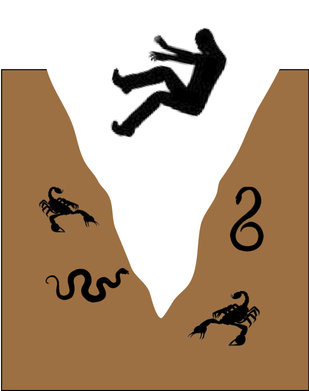
The Talmud (B. Shabbat 22a, B. Chagigah 3a) observes a redundancy in the phrase. If the pit was empty, it should be obvious that there was no water in it. Why does the Torah need to say that there was "no water in it" after saying "the pit was empty"? The rabbis conclude that the text means to say that the pit was empty only of water, but it did contain other things—snakes and scorpions. 

Water, in the Jewish imagination, often is used as a symbol of Torah. Both water and Torah are sources of life in changing forms. The rabbinic interpretation of the verse becomes a lesson about our own lives: Where there is no Torah, there will be snakes and scorpions. When we don't take the time and energy to fill our lives with a tradition that teaches us, nourishes us, sustains us, and allows us to keep growing throughout our lives, we risk that our lives will be filled instead with things that threaten us and do us harm.

The contemporary Jewish thinker, Rabbi Zalman Schachter-Shalomi, puts it like this, "The mind is like tofu. By itself, it has no taste. Everything depends on the flavor of the marinade it steeps in." 
If we don't feed ourselves with Torah, we will be fed by something else. 

I do not claim that a person must be religious in order to be good. I do not teach that the Torah is the only path to living a life that is meaningful and fulfilling. But, if a person does not fill his or her life with a soul-broadening tradition that represents thousands of years of struggling and searching for the highest within the human spirit, what will fill that person's life? Many of the alternatives our society has to offer—television, video games, our work and leisure activities—can be as dangerous to our souls as snakes and scorpions are dangerous to our bodies. 

Torah is more than a collection of children's stories. Judaism is not just a collection of  antiquated rituals. Our tradition offers much more than a basic lesson in good behavior and moral development. It gives us life and a path to finding, meaning, fulfillment and joy.


Other Posts on This Topic:
Nitzavim-Vayeilech: Is There Such a Thing as a Religious Reform Jew?
Bereshit: First Crime, First Punishment

Kayaking and Being There

12/1/2012

 
I took eight Confirmation students on a Shabbat kayak trip today with the help of my friend, Rabbi Michael Birnholz, and the folks at Tropical Kayak Tours. While we had more rain and a bit cooler weather than we wanted, it was glorious to be paddling on the Indian River Lagoon on the first day of December. (I'm still a northerner who finds it remarkable that anything can be done outdoors in December that does not involve a wool hat and insulated gloves.)
Picture
We spent the afternoon on the water, learning about the living things in and around the lagoon, studying some Jewish texts, and watching the dolphins (who were also watching us). We spent time on a small island where we did a scavenger hunt inspired by the writing of Rav Kook, the great Torah scholar who served as the first Ashkenazic Chief Rabbi of Palestine. Our theme for the day was appreciating the natural world, opening our senses, and allowing ourselves to be awake to each moment.

I taught one of my favorite texts, a teaching from Rabbi Menachem Mendl of Kotzk, the slightly mad and reclusive sage who is known as the Kotzker Rebbe. This teaching is an interpretation of a verse from the book of Exodus:
“Adonai said to Moses, ‘Go up to Me on the mountain and be there. I will give you the tablets of stone, the Torah and commandments that I have written for you to teach” (Exodus 24:12). 

There appears to be a difficulty with what God says. If Moses goes up to the top of the mountain, of course he is there! Why then the emphasis on “Be there”? This is proof that even after one strains to climb all the way up to a peak, it is still possible not to be there. You may indeed stand upon the mountain, yet your  head is in a different place. The main point is not the ascent, but actually to be there, and only there, and not be above or below at the same time.
It is not often that you see a group of fourteen- and fifteen-year-olds who have the spiritual awareness to spend an afternoon in a kayak with the kind of mindfulness I saw today. Each of them, in his or her own way, showed an appreciation for the importance of "being there" — of taking in a beautiful place, of being genuinely curious about the world, of letting the experience happen without demanding too much from it, and just allowing the truth of the moment to emerge. 

It is with great pride that I say that we did not just go on a kayaking trip. We were there.


Other Posts on This Topic:
Lifting Our Hands
God of the Natural or the Supernatural?
Forward>>

    Welcome

    This blog is about living a joyful Jewish life and bringing joy to synagogues and the Jewish community. Join the conversation by commenting on posts and sharing your experiences. For more on the topic, read the First Post.
    "Like" Reb Jeff on FB

    RSS Feed

    Enter your email address to subscribe to Reb Jeff posts by email

    Follow Reb Jeff's Tweets

    Recent Posts

    Purim & COVID-19
    ​The Honor of Heaven
    Chasing Our Own Tails
    Drilling Under Your Seat
    Change the World
    Self-Righteousness
    Where We Came From
    What We Must Believe
    ​Is Passover 7 or 8 Days?Origin Story
    Va'eira: Leadership​

    Jeff's Favorites

    • First Post
    • Searching for How the Bible Defines Marriage 
    • The Difference between God and Religion
    • In the Beginning of What?
    • Rape, Abortion and Judaism
    • Ten Thoughts about Being a Rabbi
    • Temple Dues and Don'ts
    • A Pesach Lesson from Yoga
    • The Purpose of the Torah

    Torah Portions

    Genesis
    Bereshit
    Noach
    Lech Lecha
    Vayera
    Chayei Sarah
    Toledot
    Vayetze
    Vayishlach
    Vayeshev
    Miketz
    Vayigash
    Vayechi

    Exodus
    Shemot
    Va'eira
    Bo
    Beshalach
    Yitro
    Mishpatim
    Terumah
    Tetzaveh
    Ki Tisa
    Vayakhel
    Pekudei

    Leviticus
    Vayikra
    Tzav
    Shemini
    Tazria
    Metzora
    Acharei Mot
    Kedoshim
    Emor
    Behar
    Bechukotai

    Numbers
    Bamidbar
    Naso
    Beha'alotecha
    Shelach
    Korach
    Chukat
    Balak
    Pinchas
    Matot
    Masei

    Deuteronomy
    Devarim
    Va'etchanan
    Ekev
    Re'eh
    Shoftim
    Ki Tetze
    Ki Tavo
    Nitzavim
    Vayelech
    Ha'azinu
    Vezot Haberachah

    Holidays
    Shabbat
    Rosh Chodesh
    Pesach/Passover
    Omer Period
    Yom HaShoah
    Yom HaZikaron
    Yom Ha'atzma'ut
    Pesach Sheini
    Lag B'Omer
    Yom Yerushalayim
    Shavuot
    Fast of Tammuz
    Tisha B'Av
    Tu B'Av
    Rosh Hashanah
    Days of Awe
    Yom Kippur
    Sukkot
    Hoshanah Rabbah
    Shmini Atzeret/
    Simchat Torah
    Chanukah
    Tu BiShvat
    Adar (Joy Increases!)
    Purim

    Archives

    October 2025
    September 2025
    October 2024
    October 2023
    November 2022
    September 2022
    May 2022
    January 2022
    September 2021
    September 2020
    August 2020
    May 2020
    March 2020
    October 2019
    September 2019
    July 2019
    May 2019
    April 2019
    January 2019
    November 2018
    October 2018
    September 2018
    March 2018
    January 2018
    December 2017
    March 2017
    February 2017
    January 2017
    October 2016
    August 2016
    July 2016
    June 2016
    May 2016
    April 2016
    March 2016
    February 2016
    January 2016
    December 2015
    November 2015
    October 2015
    September 2015
    August 2015
    July 2015
    June 2015
    May 2015
    April 2015
    March 2015
    February 2015
    January 2015
    December 2014
    November 2014
    October 2014
    September 2014
    August 2014
    July 2014
    June 2014
    May 2014
    April 2014
    March 2014
    February 2014
    January 2014
    December 2013
    November 2013
    October 2013
    September 2013
    August 2013
    July 2013
    June 2013
    May 2013
    April 2013
    March 2013
    February 2013
    January 2013
    December 2012
    November 2012
    October 2012
    September 2012
    August 2012
    July 2012
    June 2012
    May 2012
    April 2012
    March 2012
    February 2012
    January 2012
    December 2011
    November 2011
    October 2011
    September 2011
    August 2011
    July 2011
    June 2011
    May 2011
    April 2011
    March 2011
    February 2011

    Loading
    Jewish Bloggers
    Powered By Ringsurf
    Picture