
Reb Jeff
  • Blog
  • About
  • Wedding Officiation
  • Contact Me
  • Temple Sinai

Independence Day

7/4/2012

 
Being an American and being a Jew at the same time is easy, and also not so easy.

My father's grandparents and my mother's parents came to this country because it promised a new beginning in a land where they would be free to be Jewish. They found that America was a place where they could make a living, get their children a good education and a better future, without giving up their identities as Jews. By the time of my generation and my parents' generation, being Jewish and being American at the same time was as easy as, well … apple pie and cheese blintzes.
Picture
As American Jews of the twenty-first century, we feel that the values and beliefs of being Jewish and of being American are largely the same. Jews believe in human dignity and freedom, and Americans believe in the same. The two identities blend and reinforce each other.

On Independence Day, almost all American Jews feel that they are celebrating their own holiday—as much as Chanukah or Rosh Hashanah are their holidays. For many American Jews, eating a hot dog off the grill on the Fourth of July actually is a more uncomplicated affirmation of identity than eating matzah on Passover.

And there is the rub. Has it become so easy for Jews to be American that we have a lost part of our sense of Jewish identity? 

Today, on Independence Day, I will look forward to cheering at a parade with my children and watching the fireworks at night, just like my parents did with me not so long ago. There will be no need to explain the meaning of the holiday to the kids, to teach them the words to "The Star Spangled Banner," or to tell them why we light up the sky with colored lights on the anniversary of our nation's birth. 

In a few months, I will be leading Rosh Hashanah worship at the congregation I serve, explaining to Jewish Americans why we eat apples and honey, coaxing them to sing along to "Avinu Malkeinu," and trying to help them understand the meaning of t'shuvah. There is no need to tell me which holiday is easier and feels more natural for them.

Part of that is okay with me. Judaism is hard and it is meant to be. There is no question that Rosh Hashanah makes more demands on a person's soul than does the Fourth of July. In my mind, Rosh Hashanah also offers greater rewards for those who devote themselves to it. 

Part of what makes Jewish identity so captivating to me is that it always challenges me to understand myself more deeply, to test my limits a bit further, to enter more deeply into an encounter with life's ultimate meaning. I also have labored in the vineyards of being a committed American—I spent more than a decade as a professional on grassroots campaigns for the environment, for workers rights, and for good government. While I loved that work and found it meaningful, in hindsight, I see that I did not find the same level of personal challenge and spiritual fulfillment in that identity as I find in my identity as a Jew. 

I will celebrate Independence Day today and I will love it. I will delight in the way my children cheer the parade and enjoy the glow of the pinwheels and Roman candles. I also will be glad, though, that theirs is a blended identity. 

They, and I, are Jewish Americans. We love our 236-year-old country and we love our heritage in a Torah that is a bit older than that. We love waving the red, white and blue, and we love wrapping ourselves in a teaching that draws us closer to God and the Jewish people. 

Who says you can't have both?


Other Posts on This Topic:
The Torah and the Constitution
How Does a Joyful Jew Respond to "Merry Christmas"?
Balak: Seeing God's Image in Our Enemies

7/1/2012

 
This week's Torah portion (Balak) tells a humorous story with a serious meaning. Balak, the king of Moab, hires a prophet, Balaam, to curse the Israelites. What Balak does not seem to know, or care about, is that Balaam takes his orders from the God of the Israelites. What happens next is a predictable comedy of errors.

Balaam tells Balak's messengers that he cannot do anything unless it is willed by God. When the prophet-for-hire asks God about Balak's request, God tells him that he must not go to Balak, for the Israelites are blessed. Balak, like a typical egotistical king, does not take no for an answer. On a second visit from the royal messengers, God tells Balaam that he may go to Balak, as long as he does nothing against God's will. 
Picture
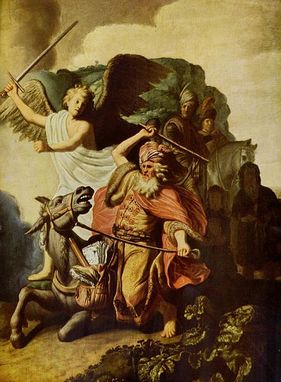
Balaam and His Ass, Rembrandt, 1626
While Balaam is on the way to Balak, God sends an angel to warn him against cursing the Israelites. Balaam cannot see the angel in front of him (some prophet he turns out to be), but his donkey does (!). Balaam beats the animal when it stops in the middle of the road before the angel. God gives the donkey the power of speech to explain himself to Balaam, but Balaam still doesn't get it. Finally, God opens Balaam's eyes, he sees the angel, and realizes his folly.

When Balaam finally reaches the place where the Israelites are camped, he instructs Balak to build seven altars and offer seven bulls and seven rams (a very expensive undertaking in the middle of the desert). Balaam then stands before Balak surrounded by all his dignitaries and proceeds to bless the Israelites instead of cursing them. The same thing happens three more times, each time Balak is enraged, but each time he keeps asking Balaam to curse the Israelites. The same result happens each time and the story begins to look like a Marx Brothers movie. (Why does the straight guy keep trusting Groucho?)

The story seems like a bit of comic relief in the final chapter of Numbers. It is the only story in the book that takes place entirely outside of the Israelite camp. The characters of Balaam and Balak seem familiar, even today, as comic icons. Balaam is the supposed "miracle man" who cannot see even the miracles right in front of his nose. Balak is the egotistical authority figure who allows himself to be fooled by the same mishap time after time.

Yet, the story has some serious undertones. We wonder, Why is this story in the Torah? What does it teach? Why was Balaam unable to curse Israel? 

According to various traditions, Balaam is either a Moabite or an Ammonite—a member of a nation that is an enemy of Israel. If you can’t curse your enemies, who can you curse?

Balaam, according to the story was prevented from cursing Israel by God, who placed words of blessing in his mouth instead of the curses that Balak wanted. In one rabbinic interpretation, Balaam could not place an effective curse on Israel because the name "Israel" contains the word "El," one of God’s names. To curse Israel would be to curse God, the source of blessing. God is, so to speak, within Israel.

Jewish tradition also offers a more universal teaching around this theme. In the first chapter of Genesis, God created the first human being, “Betzelem Elohim,” that is, “In the image of God.” Rabbi Akivah therefore taught, “One who sheds blood is regarded as though he had impaired God's image, for Scripture says, 'God made the human being in the image of God” (Genesis Rabbah 34:14). One who would strike another human being with words or with weapons strikes out against God. In some moment of clarity, Balaam recognized that he could not curse Israel without cursing God.

The comedy of the story—a foreign king who seeks to curse the Israelites through a prophet who is loyal to the God of Israel—is also recognizable in modern-day tragedies. How often do we see people warring against each other and killing other human beings in the name of a God who loves all of humanity?

It is so easy to define another human being as an enemy. It is so easy to project evil onto others and thereby justify inflicting harm on them. There may be times when war is justified as a necessary evil to prevent even greater evils from occurring. All too often, though, war is a self-justifying act that serves no greater purpose than to assert the power of the aggressor. 

When we use our power to cause harm, we have to be absolutely certain that we know where we stand morally, lest we treat an image of God as if it were evil. That is not just a moral failing, it is a tragedy for all of humanity and for humanity's relationship with God.

Furthermore, this is not just a concern of warfare. It is a problems that effects each of us on an individual level and in the civic discourse of our society. Any time we allow ourselves to see other people as an “enemy,” and thereby justify inflicting harm against them, we have failed to see the "El" within those people. Even people whom we find very difficult, or even malicious, have some spark of divinity within them. Whenever we wish ill on others, we are guilty of impairing God’s image.

Consider this in the way you act when you are angry, when you are exasperated with a spouse or a child, or frustrated by a customer, a service provider or a colleague. Think of it when you are tempted to use sarcasm or derisive humor to attack people whose opinions you reject. Use that moment as a spiritual exercise. Force yourself to see the other person as an image of the Divine, to find the name of God swallowed up within that person. 

Notice how that intention transforms the way you respond to people whom you think of as "enemies," before the cruel humor turns into tragedy.


Other Posts on This Topic:
Welcome to the Silly Season
Vayetze: Righteous Anger
Balak: How Good are Your Tents!

Forward>>

    Welcome

    This blog is about living a joyful Jewish life and bringing joy to synagogues and the Jewish community. Join the conversation by commenting on posts and sharing your experiences. For more on the topic, read the First Post.
    "Like" Reb Jeff on FB

    RSS Feed

    Enter your email address to subscribe to Reb Jeff posts by email

    Follow Reb Jeff's Tweets

    Recent Posts

    Purim & COVID-19
    ​The Honor of Heaven
    Chasing Our Own Tails
    Drilling Under Your Seat
    Change the World
    Self-Righteousness
    Where We Came From
    What We Must Believe
    ​Is Passover 7 or 8 Days?Origin Story
    Va'eira: Leadership​

    Jeff's Favorites

    • First Post
    • Searching for How the Bible Defines Marriage 
    • The Difference between God and Religion
    • In the Beginning of What?
    • Rape, Abortion and Judaism
    • Ten Thoughts about Being a Rabbi
    • Temple Dues and Don'ts
    • A Pesach Lesson from Yoga
    • The Purpose of the Torah

    Torah Portions

    Genesis
    Bereshit
    Noach
    Lech Lecha
    Vayera
    Chayei Sarah
    Toledot
    Vayetze
    Vayishlach
    Vayeshev
    Miketz
    Vayigash
    Vayechi

    Exodus
    Shemot
    Va'eira
    Bo
    Beshalach
    Yitro
    Mishpatim
    Terumah
    Tetzaveh
    Ki Tisa
    Vayakhel
    Pekudei

    Leviticus
    Vayikra
    Tzav
    Shemini
    Tazria
    Metzora
    Acharei Mot
    Kedoshim
    Emor
    Behar
    Bechukotai

    Numbers
    Bamidbar
    Naso
    Beha'alotecha
    Shelach
    Korach
    Chukat
    Balak
    Pinchas
    Matot
    Masei

    Deuteronomy
    Devarim
    Va'etchanan
    Ekev
    Re'eh
    Shoftim
    Ki Tetze
    Ki Tavo
    Nitzavim
    Vayelech
    Ha'azinu
    Vezot Haberachah

    Holidays
    Shabbat
    Rosh Chodesh
    Pesach/Passover
    Omer Period
    Yom HaShoah
    Yom HaZikaron
    Yom Ha'atzma'ut
    Pesach Sheini
    Lag B'Omer
    Yom Yerushalayim
    Shavuot
    Fast of Tammuz
    Tisha B'Av
    Tu B'Av
    Rosh Hashanah
    Days of Awe
    Yom Kippur
    Sukkot
    Hoshanah Rabbah
    Shmini Atzeret/
    Simchat Torah
    Chanukah
    Tu BiShvat
    Adar (Joy Increases!)
    Purim

    Archives

    January 2026
    October 2025
    September 2025
    October 2024
    October 2023
    November 2022
    September 2022
    May 2022
    January 2022
    September 2021
    September 2020
    August 2020
    May 2020
    March 2020
    October 2019
    September 2019
    July 2019
    May 2019
    April 2019
    January 2019
    November 2018
    October 2018
    September 2018
    March 2018
    January 2018
    December 2017
    March 2017
    February 2017
    January 2017
    October 2016
    August 2016
    July 2016
    June 2016
    May 2016
    April 2016
    March 2016
    February 2016
    January 2016
    December 2015
    November 2015
    October 2015
    September 2015
    August 2015
    July 2015
    June 2015
    May 2015
    April 2015
    March 2015
    February 2015
    January 2015
    December 2014
    November 2014
    October 2014
    September 2014
    August 2014
    July 2014
    June 2014
    May 2014
    April 2014
    March 2014
    February 2014
    January 2014
    December 2013
    November 2013
    October 2013
    September 2013
    August 2013
    July 2013
    June 2013
    May 2013
    April 2013
    March 2013
    February 2013
    January 2013
    December 2012
    November 2012
    October 2012
    September 2012
    August 2012
    July 2012
    June 2012
    May 2012
    April 2012
    March 2012
    February 2012
    January 2012
    December 2011
    November 2011
    October 2011
    September 2011
    August 2011
    July 2011
    June 2011
    May 2011
    April 2011
    March 2011
    February 2011

    Loading
    Jewish Bloggers
    Powered By Ringsurf
    Picture