A great deal has been written in recent years about the way American Jews celebrate the ritual of a young person becoming a bar or bat mitzvah. Both in satire and in serious commentary, the American "Bar Mitzvah Service," has been criticized as an over-the-top spectacle that distorts the true values of Judaism. Often, it seems, the celebration is more about a family showing off its offspring and its wealth than it is about a young person accepting the Torah.

Hollywood lampooned the way some synagogues have become "Bar Mitzvah Factories" in the 2006 film, Keeping Up with the Steins. The movie pokes fun at parents who spend more money than they can afford on a party designed to impress relatives and business associates. 
In the film, bar and bat mitzvah students are depicted as bored from memorizing Hebrew they don't understand. Even the rabbi is skewered as a pompous figure who cares more about his book tour and television appearances than actually teaching Torah. Of course, the movie exaggerates all of this to make its points, but it is funny because the caricatures are recognizable.

In 2007, Rabbi Eric Yoffie, President of the Union for Reform Judaism, spoke to the Reform Movement's biennial convention in San Diego and bemoaned how Shabbat morning worship has been "appropriated by the Bar and Bat Mitzvah families," and how congregants "who come to pray with the community often sit in the back of the sanctuary and feel like interlopers in their own congregation." Ouch. We do seem to have gotten seriously off-track if the experience of becoming a bar or bat mitzvah has turned into a circus of overblown egos that actually keeps faithful worshippers away from the synagogue.

This is not what becoming a bar mitzvah was meant to be. 

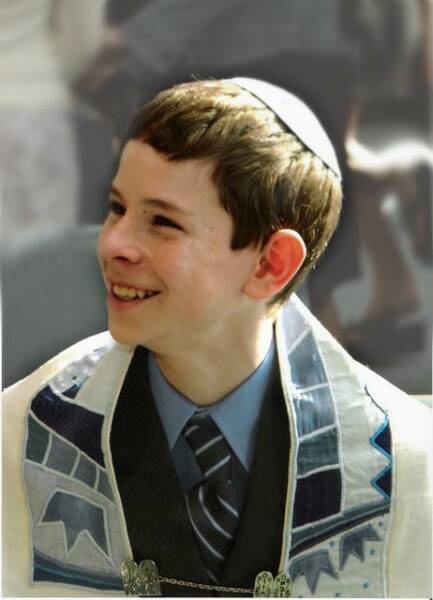
The origin of bar mitzvah is in a simple statement from Pirkei Avot. One of the sages teaches the appropriate ages for different milestones in life. "Age thirteen," he says, "is for fulfilling the mitzvot (commandments)" (M. Avot 5:21). By tradition, a boy at age thirteen is called up for an aliyah during a regular worship service. Typically, the child also chants one or more of the sections of the weekly Torah reading and the haftarah reading from the Hebrew Prophets. All of this is a way for the child to publicly acknowledge acceptance of the obligation to do mitzvot. He is called a bar mitzvah, Aramaic for, "one who embraces the commandment." 

(Despite the common misuse, "bar mitzvah" is not the name of a ceremony. The bar mitzvah is the person, not the service. "Bat mitzvah" is the feminine form. The plural of bar mitzvah is "b'nei mitzvah." The form, "b'nei mitzvot," is incorrect. Also, "bar mitzvah" is not a verb. You cannot be "bar mitzvahed." All Jewish children become b'nei mitzvah when they come of age, whether or not they celebrate the occasion at a worship service.)

In a perfect storm of religious schools that want to "get serious about standards" and parents who want to put their child on a stage, the "Bar Mitzvah Service" has become something distant from its original intention. Instead of a rite of initiation into the mitzvot, the service has become a kind of recital performance that caps years of preparation. Often, the child is expected to lead much of the service. That may be appropriate for the rare thirteen-year-old who is able to lead a congregation in worship with understanding and competence, but few actually are. No wonder most of the synagogue regulars stay away.

I should not complain too much. I have been fortunate to serve congregations that manage to keep the Torah, not the egos, at the center of the service. Maybe it is because they have been off the beaten path, on the outskirts of the urban American Jewish scene, that these congregations have a better perspective on the meaning of a Jewish child coming of age.

So, what does this have to do with this week's Torah portion? When a young man or young woman reaches the age of accepting the mitzvot, the celebration is about choosing to live a holy life. This week's Torah portion contains explicit instructions on what that means. 

Parashat Kedoshim (the second half of this week's Torah double header) opens with the verse, "You shall be holy, for I, Adonai your God, am holy" (Leviticus 19:2). It concludes with, "You shall be holy to Me, for I, Adonai, am holy" (Leviticus 20:26). In between those bookends, the portion offers instructions on the need for employers to treat their workers justly, on being honest in business, on treating rich and poor alike, on not taking advantage of the ignorance of others, on not indulging in inappropriate sexuality, and on respecting ones parents and the elderly. 

The portion includes some of the most powerful ethical teachings of the Torah, such as, "Love your neighbor as yourself" (Leviticus 19:18). The emphasis is on being holy by being a mensch

These are the lessons we want every bar and bat mitzvah to remember for decades to come, long after the service and the party are over. We want them to feel that they have entered into a covenant that offers them the opportunity to live lives of holiness by doing what is right, honorable, and just, even as they live in a world with many temptations to do otherwise. Becoming a bar or bat mitzvah should not be about leading more of the service than the neighbor's kid. It should not be about throwing a lavish party. It certainly should not be about the end of Jewish learning when it has only just begun

Becoming a bar or bat mitzvah is an invitation. It is an invitation to live a holy life.


Other Posts on This Topic:
Writing a Word of Torah
Kedoshim: Being Holy

 
 
This is the talk I gave tonight at the Havdalah service that included my installation as the Spiritual Leader of Temple Beit HaYam in Stuart, Florida.

First of all, I want to say, Thank you. 

Thank you to Cantor Beth for bringing your gift of music to this occasion. Thank you to Steve Rozansky for organizing tonight’s event, for your kind words, and for being my partner as the president of this congregation through my first nine months here. Thank you to our other speakers from the congregation this evening, Doris Etelson, Tara Zweben and Joan Burton. I so much appreciate, not just your words, but all the things you, the Board and general membership have done to welcome me to Temple Beit HaYam. I must also thank Linda Oliver, Temple Beit HaYam’s event planner extraordinaire, who has set the decor, the tone and the everything for tonight’s celebration.

I want to thank Rabbi Jonathan Kendall who has made this congregation his life work and, without whom, none of us would be standing in this room today. 

Of course, I also want to thank my friend and colleague, Rabbi Michael Birnholz, who was not only gracious in accepting the invitation to be our guest speaker today, he took it on as a personal challenge to make it as meaningful and pertinent as possible. Rabbi Birnholz and I have gotten to know each other since last summer, primarily in our work together on the Treasure Coast Jewish Film Festival. He has become a trusted friend, advisor and Cracker Barrel breakfast buddy. Thank you, Michael, for your kind words, your penetrating insights, your good humor and your friendship.

Now, for the rebuttal.

Inevitably, the question is raised: Why wait nine months to install a new rabbi? You have attended High Holiday services with me. We have celebrated Chanukah, Purim and Passover together. Your children have spent nearly a full year in religious school with me. If “installation” is the time when the delivery truck pulls up to your house and the new dishwasher, refrigerator or air conditioning unit is put in, surely I already have been plugged in and mounted, happily serving Temple Beit HaYam.

Well, yes and no.  We have gotten to know each other, but we still have a long way to go before anyone will regard me as a fixture here. This installation service can be regarded as both the “end of the beginning,” and the beginning of the next phase of the process in which we form a lasting covenant as congregation and rabbi.

It is altogether fitting that we have waited until this point in the process. If we had done this installation last summer, it would have been a ritual in which I would have greeted people I did not know and the congregation would have greeted a rabbi that it did not know—very lovely but not very real. By waiting some time after we have had a chance to get to know one another, we are making this installation one that has real meaning, the formal declaration that this rabbi and this community belong together in mutual understanding, respect and joy.

Looking back at the last nine months, I see the beginning of a promising future to complement this congregation’s brilliant past. Temple Beit HaYam was founded nineteen years ago by Jews who loved living on the Treasure Coast, but who knew that the experience would not be complete without a place to express themselves as Jews. This congregation was founded to give our children a place to learn their tradition and to celebrate their lifecycle events. It was founded to provide a place for us to come together for meaningful worship and social gathering. It was founded so that, together, we could make the Jewish community in our region known and recognized by the broader community as a force for doing good and for representing our faith and our people with pride. That vision is still present in this congregation and it is still growing. 

We now have about 100 students enrolled in our religious school. This year, we made improvements to our program by stepping up our commitment to training our existing teachers in classroom management skills and by bringing in more teachers with extensive classroom experience. We have extended our commitment to education by offering more to our adult learners. Our Temple’s commitment to education is alive and thriving.

Over the last nine months I have learned more from you about what you seek in worship experiences. Our Friday night services have been very well attended this year, and you tell me that it is because services have been lively, joyful, engaging and intellectually stimulating. There is nothing I enjoy more in our services than seeing all the people who get up out of their seats to join us when we dance to L’cha Dodi and circle the bimah, sometimes two rows deep. If weekly worship services are the heartbeat of a congregation, the cardiologist will be very happy with Temple Beit HaYam. Our heart is beating strong.

Temple Beit HaYam is now reaching out into the community in ways that are being noticed. Every month, we send a crew of volunteers to Immanuel Lutheran Church in Palm City to prepare and serve meals in the Souper Sunday program that feeds some of the many in Martin County who are food insecure. We’re making a difference and, increasingly, people know that we are here. I have found terrific partners for interfaith dialogue and action among the clergy in Martin County, and I am honored that some of them are here with us this evening. Thank you, my friends, for being here.

The greatest promise, though, that I see in Temple Beit HaYam is not to be found in any education program, worship service, or social action project. The greatest promise and the greatest asset of this community is the very people of the congregation. You are warmly welcoming, not only to a new rabbi, but to every person who walks into this building. I have seen it in the way that you greet newcomers and the way that you make everyone feel that they belong here. You are tremendously generous and giving. I have seen it in the way that our congregation’s leaders and volunteers devote themselves to this community as a labor of love, and also in the way you, our members, support this congregation financially. You are joyful in your Judaism. I have seen it in the way you rise to every challenge I offer to study, worship, sing and dance our tradition together with delight. If we hold on to those qualities, there is nothing that we cannot do together. 

Our vision for the future of the congregation is still taking shape, but some things are starting to come into focus. In the coming year, I would like to see our commitment to education deepen. I would like to  explore the ways we engage our post-b’nei mitzvah students, deepening and strengthening their experience in our youth groups and Confirmation process. I would like to expand our social action efforts so we can do more good for more people in the community. I would like to deepen our congregation’s commitment to the State of Israel, and that may include a congregational trip to Israel next year. I would like to create more opportunities for us to talk to one another so that we can dream together about what our congregation could yet be. 

Last summer, I had a marvelous introduction to this congregation in a series of “Meet and Greets” in members’ homes. Our incoming president, Karen Weisberg, and I are planning a similar series of “Town Meetings” this coming summer for members to talk with each other about their experiences as congregants and to share their hopes for the Temple’s future. It’s a conversation I look forward to continuing with you.

I know that most of you have heard about the curious list of so-called “top” rabbis on which my name appeared last week. I’m delighted that the congregation has taken pride in the distinction. However, it is with a bit of embarrassment that I have to admit that the idea of “top rabbis” is foreign to my sense of what a Jewish community is all about. To me, Jewish communities are dynamic organisms in which all the parts must work together for success to be achieved. You cannot have a top rabbi without a top congregation. Even if a rabbi gives wonderful sermons, shows great  compassion to people in need, and leads memorable and moving lifecycle rituals, it will not matter without a congregation that also has a thirst for learning and a commitment to leadership, a congregation that demonstrates care for mourners and rejoices with every bride and groom and every bar and bat mitzvah. I thank you for being that kind of congregation.

Rabbis and congregations enter into new relationships with each other with a little bit of trepidation and with a lot of hope. In all humility, I want you to know how grateful I am for the opportunity to serve this community that has taken a great leap of hope in entrusting me with its spiritual leadership. I know that change is difficult, and you have shown a remarkable amount of trust in me. I promise you my every effort to make myself worthy of it. I look forward to a long journey in which you and I build a relationship of mutual understanding, respect and joy.

Let us continue the journey together.


Other Posts on This Topic:
Beginnings and Endings
 
 
Any woman who gives birth must have her needs met and more.

That sounds like a line from a policy statement by Planned Parenthood or the Children's Defense Fund, but I read those words in a collection of traditional commentaries, Iturei Torah (4:67), quoting the Belzer Rebbe. The statement is not derived from any modern conception of the rights of women and children. Rather it is derived from a passage in this week's Torah portion that, on the surface, appears to be talking about how women are ritually impure after giving birth.
The commentary observes, as did Rashi, that these verses about the ritual of purification for such a woman appear to be out of order:

[The priest] shall offer [the mother’s offering of a sheep and a dove] before Adonai and make expiation on her behalf; she shall then be pure from her flow of blood. This is the Torah of one who gives birth to a male or female child. If she has insufficient means for a sheep, she shall take two two pigeons or doves, one for a burnt offering and one for a purgation offering. The priest shall make expiation on her behalf, and she shall be pure. (Leviticus 12:7-9)

Why, they wonder, is the offering of the sheep and dove followed by the statement that "This is the Torah"? Is the offering of the poor woman who can only bring pigeons or doves not also Torah? The classical answer is that the offering of the wealthy woman is the way that it ought to be for everyone—that is the Torah. The Torah acknowledges that there are poor women who give birth who cannot afford the prescribed offering, but that is a disgrace. It should not be that way.

The Belzer Rebbe taught, "In truth, 'The Torah of one who gives birth' is that she should have the means to bring the offering of a wealthy person. According to the Torah, any woman who gives birth must have her needs met and more.  But, if it sometimes happens that 'she has insufficient means' this is not according to the Torah."

Whose responsibility is it to make sure that her material and spiritual needs are met? The Torah seems to say that we should not expect God to provide for her. God has made provisions for her in the case the responsible party fails to do the right thing. Who is the responsible party? It is all of us, of course. As the famous statement from the Talmud declares, "All Israel is responsible for one another" (B. Shevuot 39a). 

We can have delightful discussions and arguments about how this should happen. Should the government be responsible for caring for her needs? Should it be the responsibility of private charities to support women's reproductive health care? Our texts do not say. Yet, there is no ambiguity in our tradition about communal responsibility. It is up to us to make sure that the disgrace of a poor pregnant woman never happens.

We are responsible for each other, particularly for those in need, particularly for those who give life. No woman, regardless of who she is or how she came to be pregnant, should be left without all her needs (and more) met as she brings new life into the world.


Other Posts on This Topic:
Tazria: Newborn Spirituality
 
 
Yesterday afternoon, our Hebrew School celebrated Yom Ha'Atzma'ut, Israeli Independence Day. Mazal tov, Israel, on turning sixty-four.

As you can see in the video above, our children danced Israeli dances, sang Israeli songs, made Israeli flags and Hebrew name bracelets, and ate falafel and birthday cake. While the video has some tongue-in-cheek humor to it, the sentiment and mood of the occasion was genuine. We celebrated the Jewish State, the home and heart of the Jewish people, with joy. (Thank you to our teacher, Ilene Goldstein, for making the video).

May it always be so. May the time come when all of our thoughts about Israeli will be about a place that is the embodiment of Jewish community, Jewish values and the fullest expression of Jewish civilization. May we see a time when we only think of Israel with childlike affection and joy. 

We all know that, for most American Jews, there is a darker shadow over our thoughts about Israel. We think about her vulnerability to hostile neighbors and we are unsettled by deep fissures in her society between religious and secular, Westerners and Orientals, Jews and Arabs, Right and Left.

Those shadows are real and we don't do Israel any favors by pretending that they don't exist. When you love someone, you love the whole person, not just the parts you find attractive, pleasant and appealing. I want to love all of Israel. 

But birthday parties are for celebrating. We need to celebrate the nation, the land and the people that are the heart of the Jewish experience in the contemporary world. Israel is still the homeland that we sought through two thousand years of exile. It is still the one place in the world where Jewish values are put to their truest test. It is still a spiritual home for all Jewish people everywhere, even those who have never been there. It is still the country where the most Jews are born every year.  If you love Jews and if you love Judaism, you have to love Israel.

Happy birthday.
 
 
Now this is embarrassing. 

Every year for the last several years, Newsweek has run a list of the "Top 50 Rabbis," and each year it garners as much criticism as attention. (Well, I suppose that criticism is attention, and the fact that controversy creates interest is not lost on Newsweek and its advertisers.) This year's Newsweek list was strategically timed, coming out at Passover.

I cannot say anything bad about about the men and women on the list. Those I know personally are truly excellent rabbis—talented, brilliant, compassionate and passionate people. Let me disclose (and brag) that four of the fifty are my teachers, five are my friends, and I went to high school with one of them, too. 

Most of the problem with the list, I think, is just the idea of ranking rabbis at all. It reminds me of the way I used to rank baseball cards when I was a kid. (What's better, a Bruce Sutter rookie card or a Rollie Fingers MVP card?). "Collecting" rabbis like this seems contrary to the values that we most admire in rabbis. Can you rank one human being created in the image of God over another?

Well, now it seems that I have to get down off of that sanctimonious high horse, because someone has put me on a list of "top" rabbis. Contending that Newsweeek's list does not represent the "unsung heroes of the rabbinical world," My Jewish Learning has compiled their own list of "America's Real Top Rabbis 2012," and I'm on it. Looking at the list, it also includes many fine rabbis who do their work with sincere love of Torah, skill in meeting the needs of people in need, and dedication to the communities they serve. I'm honored to be counted among them. 

Yet, the list in My Jewish Learning is, after all, just another list. It does not include the movers and shakers of the rabbinic world—as does the Newsweek list—but it is somebody else's attempt to rank and rate. Being on the list does not really mean anything. There are rabbis on the list who give great sermons, who are great teachers, and who help people through crises with care and compassion. There are rabbis who have the same abilities who are not on the list. How do you rate one rabbi above or below others based on such qualities?

I can imagine the whispers in my own congregation: Who does he think he is, Carl Yastrzemski?

So, thank you, My Jewish Learning, and thank you to the folks who nominated me. I'm flattered and humbled. However, to climb back on top of that hobby horse of mine, let me also say that Judaism in the twenty-first century does not really need "top" rabbis. We don't need to agonize over who ranks high or low. My baseball card collection is now resting on the bottom of a landfill (thanks, Mom), and that is where this year's top rabbi lists will end up, too.

What we do need is a Judaism that brings meaningful experiences into people's lives and that allows us to remember the joy and purpose of our existence. You cannot buy that experience with a "top rabbi." It is up to all of us to build it together.
 
 
Not every day in the life of a rabbi is as busy as today was for me, but days like this remind me why I love my job. My day included teaching in our religious school, leading the conversion of a six-month-old baby, participating in an interfaith dialogue group, and officiating at a wedding. 

First, let me tell you about religious school. I teach the nine students in our Confirmation class, and they are just three weeks away from the end of their formal Jewish education. I feel like we have so much more to learn together than time will allow. Teaching a classroom full of 15-year-olds has its challenges, especially when the kids know that the class doesn't "count" in the same way that secular school classes matter to their GPA and eventual college applications. Today, though, the students were attentive and engaged. Our conversation about ethics seemed to make an impression on them, especially when we talked about cheating in school and how it relates to Jewish law and values. I thought I saw some eyes widen when I explained that the ethical choices in life only get harder after high school. 

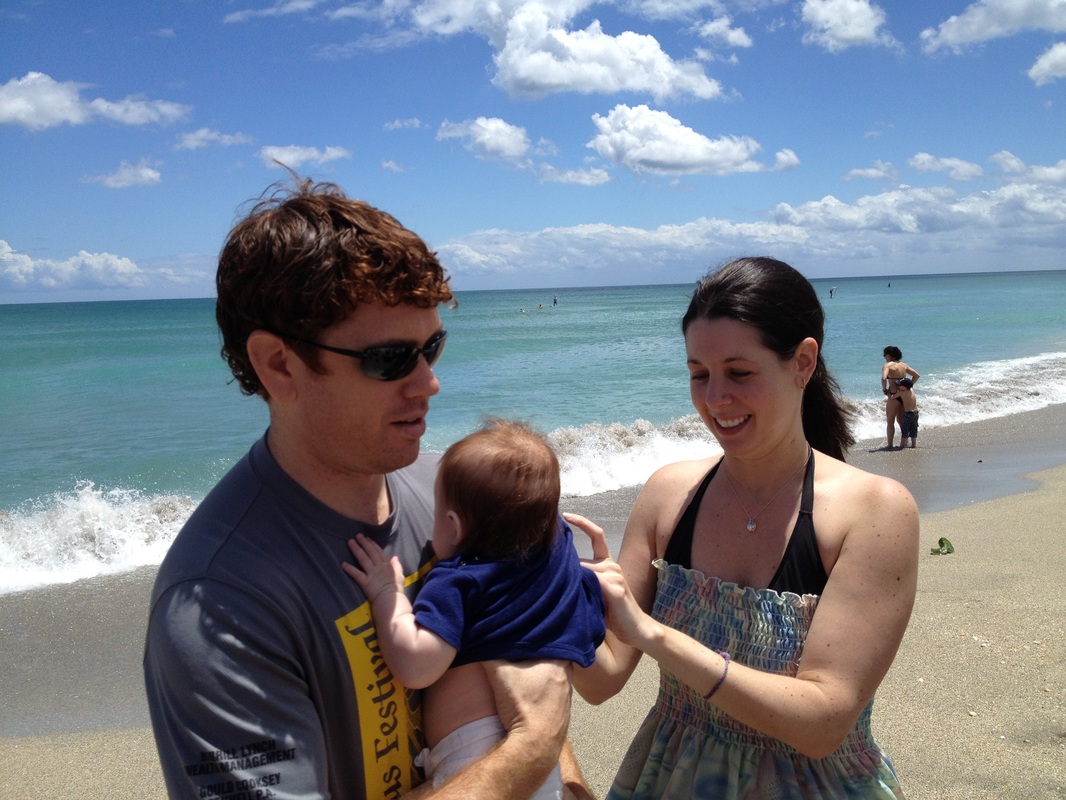
Next came the baby. I don't know anyone who doesn't love holding a baby and it is one of the nice perks of being a rabbi. This beautiful bundle was a little girl who was adopted by a young couple living temporarily in our community. We took her to the beach, immersed her in the warm waters of the Atlantic Ocean, and read the blessings that made her a member of the Jewish people. The fact that the waves were crashing all around us—the mom got swept off her feet at one point—only made the ritual more meaningful. We had to struggle a bit to get this little girl far enough off the shore into waters deep enough to cover her little body (very briefly). When we signed the conversion and naming certificate back on land, we knew that the transformation of her identity had been acquired only with real effort and determination.

The interfaith dialogue group I attended this afternoon has been meeting since last fall. We gather monthly at the local UU church to learn about each other's faith in a spirit of genuine interest and openness. Today's meeting was particularly interesting to me because, after months of shying away from areas of potential controversy, we really started to talk about an issue—it happen to be the role of women—that we view very differently in our different faiths. There seemed to be some sense of relief in the room that we were able to acknowledge our differences without undermining our ability to communicate constructively. That's progress. 

My long rabbinic day ended back at the synagogue with a wedding. The couple was not local, but has a local family connection. After meeting with them over the phone for months to help them prepare for this big day, it was wonderful finally to see them standing right in front of me under the chuppah, pledging their affection, their support, and their lives to each other. Couples usually want their weddings to be distinctive—different, somehow, from every other wedding. However, I find that the things that make most weddings powerful experiences are the things that they all have in common. When two people stand side-by-side in front of the preacher and say with utter confidence and belief that they will love each other for the rest of their lives, well, that is a moment that sounds to me like it was invented at the dawn of creation and will last for all eternity.

What a day. After driving around town, from home to synagogue, to beach, to church, to synagogue and back home again, I'm pretty exhausted. The day included a number of costume changes—slacks and blazer to bathing suit, bathing suit back into slacks, and then to a suit and tie. It also included a lot of talking about a broad range of topics—ethics, mikveh, gender, identity, marriage, ritual and more. I'm just grateful that I could keep them all straight in my head. 

Being a rabbi is not just about putting on a good show (but I don't underestimate the importance of that aspect). Much more, it is about making connections between human beings and helping them discover the hidden, secret meanings behind those connections. The thread that ran through this very busy day is the struggle to make sense of it all. I think about the Confirmation kids struggling with pressure from their peers and pressure from their parents and schools. I think about a young couple wanting to know their little girl will be part of the great chain of connection that binds the generations. I think about people from different backgrounds who want to find a balance point between celebrating their commonalities and acknowledging their differences. I think about a couple, entering together the great unknown of the rest of their lives together. It's all about connections.

It's been a good day.


Other Posts on This Topic:
Ten Thoughts About Being a Congregational Rabbi
Ten Observations on Starting at a New Congregation
 
 
A few weeks ago, I had this conversation with my 13-year-old daughter who was reading Elie Wiesel's Night for a school assignment. I was driving her home with her in the back seat.

I said, "You know, it's not a subject I like to talk about."

And she said, "I know."

"It's hard for me not to take it personally, especially when I think about my grandfather and how his sisters were murdered."


There is a long pause.


"But, you know, if it had not been, neither you nor I would ever have been born. My mother would have stayed in France. She would have grown up there and my parents would never have met. And there is no knowing what the world today would be like. Is it possible to wish for one's own non-existence?"


She doesn't answer.


"You bet it is."


I think about this as we drive over the South Branch of the St. Lucie River, almost home.
"But we live in the world we are given, not the world we wish for."


In the rearview mirror, I see her reading her book.
 
 
How do you bring God's presence into your life? Is there a way to summon God to appear for you? For religious people, who want to understand what God wants from them and who yearn to bring themselves closer to God, these questions are an overwhelming imperative. We want to feel God with us. This week's Torah portion, according to some commentators, contains a clue about how to do that.
We are finally back to the regular cycle of Torah readings this week after two weeks of special readings related to the holiday of Passover. With this week's portion, Shemini, we resume the story of the book of Leviticus where we left off, with Aaron and his sons about to be ordained as priests. 

The portion begins:

It was on the eighth day that Moses called Aaron, his sons, and the elders of Israel. He said to Aaron, “Take a calf of the herd for a sin offering and an unblemished ram for a burnt offering and offer them before Adonai. Tell the Israelites, '…Today Adonai will appear to you.'" They brought the things Moses commanded to the front of the Tent of Meeting and the whole community came forward and stood before Adonai. Moses said, “This is the thing that Adonai commanded you to do so that Adonai's Glorgy will appear to you.” (Leviticus 9:1-6)

The great Chasidic commentator, Menachem Mendel of Kotzk (known as the "Kotzker Rebbe"), wonders what is "the thing" is that the Israelites must do to cause God's Glory to appear to them. The Kotzker argues that it cannot be just the sacrifices, because that would be redundant. The Israelites already had brought the required sacrifices. Why, asks the Kotzker Rebbe, does Moses again have to say, "This is the thing that Adonai commanded"? What is "the thing" that will cause God's presence to appear?

Don't pretend that you don't want to know, too. If there was some thing you could do that instantly would cause God's presence to be revealed before you, wouldn't you do it?

I don't think we're talking about a parlor trick here. I don't think the Kotzker Rebbe imagines that there is some abracadabra that will pull a divine revelation out of a hat. I think it actually is something much more simple than that. There are things we can do, simple things, that allow us to experience God in our daily lives. What are they for you?

For me, it can be as simple as holding the hand of my wife or my child and saying what is in my heart in that moment. It can be as simple as taking the time to listen to a friend or a congregant who is going through a difficult time and letting the words enter deeply into me. 

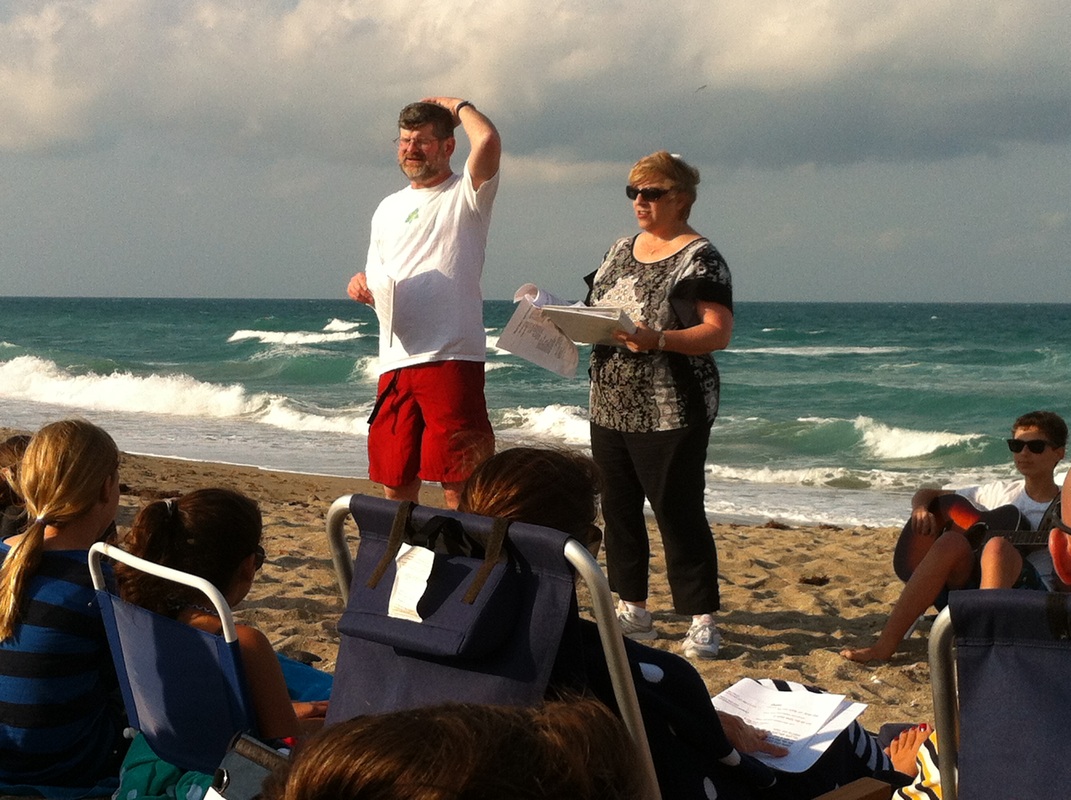
Last Friday evening I had the pleasure of leading the congregation in a Shabbat service on the beach, and that reminded me of another way to make God's presence instantly available. Looking out over the ocean, watching the low angle of the sun's last beams brightening the clouds, made me feel that I could discover the revealed presence of God all around me. 

It is not just that I have the fortune of living in a very beautiful place and that I had a wonderful group of people with whom I can share the moment (although those things don't hurt). It is also that the moment reminded me of how infrequently we give ourselves the luxury of just stopping to notice the beauty that surrounds us all the time. We can allow God's presence to be revealed to us whenever we want, just by taking the time to appreciate the wonders of the world around us, the miracle of our own bodies, the amazing good fortune we have just to be alive in a world filled with wonders.

This is the thing that God has commanded you to do so that God's Presence will appear to you.


A story for the last day of Passover

There was once a king who had heard about another ruler on a distant shore who was known for his mastery of wisdom and for his army considered the finest in the world. The king wanted to know more about the stories he had heard. Were they true? Did such a king really exist or was he merely a fabrication of legends and myth? The king wanted to know, also, what stories were told about himself in distant places. Did those stories tell the truth about him? Did people believe things about him that were all lies?
To determine all of this, the king sent his most trusted advisor to cross the sea and to learn as much information as he could about the far-away king, and also to find out what, if anything, was known about himself in that place across the sea.

It took the advisor a long time to reach the kingdom that his king had heard about. All along his journey, by foot and by sea, he asked people both about his own king and about the king he was traveling to visit. He noticed that as he travelled further from his own kingdom, the less people knew about his king. He noticed that they confused him with other kings of lesser lands. He was frustrated when people assumed that they knew all about his king, and told him stories about him that were completely unfounded in truth. 

It did not matter to the advisor whether the stories people told about his king made him appear less than he really was or far greater than any king could be. He wanted people to know his king for the true person that he was, and was angered when people argued that they knew more about the king than did his own closest advisor!

It was with tremendous frustration and and unconsolable sadness that the advisor finally entered the kingdom of the foreign king he had been ordered to seek. Immediately, the advisor asked to be taken to the king and given an audience to bring greetings from the king whom he served. However, all the officers and courtiers of that kingdom told him the same thing: their king did not meet with anyone. He ruled from a high tower of his castle and not a single person from the kingdom had ever even seen the king. They admitted that they did not even know his name. They told the advisor to return to his own kingdom and tell his master that he had failed in his mission. He would never gain admission here to see the king.

The advisor would not be satisfied with this answer. While he continued to seek admission before the king's presence, he asked people to inform him about the king's qualities. Was he, indeed, a master of wisdom? Did he control vast armies considered the finest in the world? The people were mystified by these questions. Was their king wise? Who knew? No one had ever heard him speak. Was their king a great military master? Who could say? The kingdom had been at peace for centuries and there had been no need to deploy armed forces. The people of that kingdom had no idea how to answer the advisor's questions.

One day, while investigating the castle of the invisible king, the advisor entered the king's kitchen and asked a boy he found there, "Who takes food up to the king?" The boy only stammered, not knowing what to say. But the advisor was clever. He smiled at the boy and explained, "I have been asked to take the man's place today and deliver the king's food. I need to know where he is." 

The boy seemed relieved by this and pointed out to the advisor an old man who sat in the corner of the kitchen. The boy explained to the advisor that the old man took a platter of simple food, raw vegetables and boiled grain, up to the king's room three times a day. He said that the old man left the platter at the king's door and returned to the kitchen—breakfast, lunch and dinner. He was the only person who ever ventured within a thousand feet of the king's door.

The advisor next went to the old man and interrogated him about the king. What did the king look like? How old was he? What was his name? Was he as wise as he had heard? Was he as powerful? Why did he eat such simple food while he commanded the wealth of an entire nation? The old man protested that he did not know the answers to any of the advisor's questions. He merely did what he had been ordered to do. He took the meals up three times a day and returned to the kitchen. He knew nothing more.

The advisor felt that he was on the edge of madness. He had travelled so long and so far to find the information his master required. All he had found was that nothing he had heard was true. He wondered if there truly was such a thing as truth. People believed what they chose to believe. They were more committed to what they said than what they heard. No one questioned their beliefs, no matter how unfounded those beliefs might be. He was astonished by the stupidity of a nation that knew nothing of their own king—his wisdom or the strength he commanded. They did not even know his name. To make matters worse, they showed no interested in doing anything to find out.

The advisor resolved that, the next day, he would follow the old man up the stairs to the king's door. Even if he would only watch the old man leave the food at the foot of the door and return to the kitchen, he would at least know that this much of what he had heard was true.

The advisor hid himself behind the curtains that lined every hallway of the palace and watched as the old man took the platter of raw vegetables and boiled grain up the stairs. He followed as closely as he dared, so as not to be observed. The old man appeared to be oblivious to the advisor's presence. As the advisor followed at a distance, he heard the old man singing songs quietly to himself up the stairs. He heard him sing:

My lady who is fair and has a gentle voice
Sits on my knee as she knits socks for the babe.
Will the child who grows in your belly
Be as pleasant and fair as you, my love?
Will the child be all that we hoped
Last summer when we clung to each other long?

The steps of the old man continued up through more flights of stairs than the advisor could imagine. He was amazed that such an old man could make this long journey, up and down, up and down, up and down, each day. The advisor himself felt weak from the climb and thought he was about to collapse when, finally, he saw a single door at the top of the last step of the stairs.

The advisor saw that there was no place at the foot of the door for the old man to leave the platter. The door itself was quite plain, with only a simple iron latch and no place to put a lock or key. In amazement, he watched as the old man put his finger to the latch, lifted it, and walked directly into the room.

The advisor crept slowly up to the door, not knowing when the old man would walk back out. The staircase was quite narrow in its final flight, and there would be no place to hide should the old man surprise him. 

The advisor carefully peaked into the room and saw little that suggested the presence of a king. There was only a bare table of oak and, he now saw, a simple oak chair in which the old man sat as he ate the king's meal. 

Incensed, the advisor walked defiantly into the room and confronted the old man. He said, "What perverse deception stands at the top of this kingdom! There is no king! There is no one who commands this land's armies! There is no wisdom that guides it! There is nothing but lies and lies about lies at the heart of what I was told was a land of seeming perfection! How can this be?"

The old man did not even stop the spoon that lifted the cold cooked grain up to his chin. He put the food in his mouth, tasted it, and swallowed before he spoke.

"Were you not told when you first entered this land that you would never gain admission here to see the king?" the old man asked.

"I was," said the advisor. "Yet, I was determined to discover the truth, and now I have."

"You have discovered nothing," said the old man. "You were told the truth. It is you who have lied. You were the one who told the boy that you were ordered to take my place. Each person in this kingdom has told you the truth exactly. They do not know their king. Only I serve him by bringing him his meals."

"But you eat the meal yourself!" yelled the advisor. "If there is a king, where is he?"

"You know the answer," said the old man. "You know better than anyone here, for he sent you on this mission to discover how well he is known. Now you have your answer. Go back to him."


(offered with admiration for Rabbi Nachman of Bratzlav's story, "The Humble King")
 
 
Picture
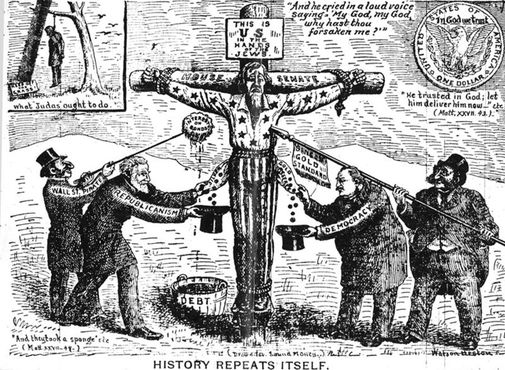
An antisemitic cartoon from Sound Money magazine in the U.S. presidential election of 1896.
I have made the theme of this blog the pursuit of joyful Judaism. I’ve tried to keep that message in all of my posts, even leaving some of my sermons and other writings off the blog when they did not fit the theme. That does not mean, though, that I fail to recognize that not everything in the Jewish experience is joyful.

It is difficult for me to write about antisemitism, the Holocaust, and threats against the State of Israel, but not because they are unimportant to me—just the opposite. As the child of a mother and grandparents who had to run for their lives from France in 1940, and as the grandnephew of other relatives who were not so lucky, I take threats to the Jewish people extremely personally. 

I acknowledge that there is much in Judaism, much in Jewish history, and much in the situation of Jews today, that is painful. Yet, my choice has been not to allow those realities to determine the way I experience Judaism. I choose to be joyful as a Jew because, through joy, I find that I defeat hate.

There is much at this time of year, though, that makes that choice difficult. Historically, Passover has been the season that excited anti-semites into blood libels—bizarre claims that Jews use the blood of Christian children to make their Passover matzah. Easter has been the holiday that provokes charges of deicide—the ancient accusation that Jews were responsible for the death of Jesus.

Two days ago, I had a rude reminder. An elderly woman—who did not leave her name or other identification—left a message on my office voicemail telling me that she is “angry at the rabbis,” and, I assume, she meant to include me. She said that she is angry because of the way the rabbis provoked the Romans into executing Jesus. She railed that, while I celebrate my freedom during Passover, I should also teach my people about the historical crime of the Jewish people.

This is the point at which I take a deep breath and try not to scream.

I know what all of my Christian friends and colleagues will say to me at this point. Yes, of course, I know that one mentally ill person with a telephone does not speak for all of Christianity. I know that this woman probably deserves more pity than condemnation. I know that only a small minority of American Christians harbor this kind of hatred. I know all that and, I assure you, I don’t want anyone to apologize for the words of one crazy lady.

Yet, I also want you to know that this kind of antisemitism is real. This is not the first time I’ve experienced it, even if I don’t talk about it much. It hurts.

And, yes, I do want to bring this experience back to the theme of this blog. How do we, as Jews, celebrate our Judaism with joy when we know that our history is punctuated with hatred, persecution and genocide? How do we keep ourselves from slipping into a sorrowful view of our very identities as Jews? How do we keep Judaism from becoming a religion that is primarily about self-pity and our own suffering?

This is a serious question for me. I was deeply turned off of Judaism as a youngster because of the emphasis on suffering I experience in my religious school education. Admittedly, I was a teenager in the 1970s, a time when the Jewish community was over-compensating for decades of silence about the Holocaust. I remember a textbook in religious school that had a page with ten thousand tiny dots on it. The text explained that it would take six hundred such pages to show the number of Jews who were murdered in the Holocaust. I remember looking at that page and thinking, “Is this really what Judaism is all about?”

Obviously, I discovered that Judaism is about a great deal more. It is about living life with a purpose beyond mourning our past. It is about discovering that our lives have deepest meaning and greatest fulfillment when we reach toward our highest aspirations. It is about celebrating the divine presence we feel in our most profound moments. It is about living with wonder at the miracle of existence. Now, when I teach teenagers, I want them to learn that lesson first, long before they hear me say a word about Jewish suffering.

The darkness is there, but it cannot define us. The joy I experience as a Jew would not be as deep or as bright as it is if I did not acknowledge the darkness that the light illuminates. Judaism is the tradition that admits the darkness, yet defies it. We do not deny that we live in a world that is far from what God intended when, in the act of creation, God called it “good.” There’s a lot in the world that’s not so good. But, we still hope for a better world and act to create it.

That voicemail message really got the better of me for a few days. I asked my colleagues what they thought I should do about it. Most of them told me to ignore it, which was probably good advice. For me, though, reflecting on the anger, fear and hurt it provoked in me is just another reminder of how important it is for me to step out of the darkness and reaffirm the light of Jewish joy.